
Adopting client-side AI agent automation across enterprise organizations means balancing developer velocity, infrastructure expenses, and strict data security compliance. Alibaba’s page-agent provides a solid foundation for enterprise web automation when deployed with a disciplined governance framework.
Building on the security and architecture principles from our Model Context Protocol enterprise guide, this blueprint outlines a 4-phase procurement strategy, financial ROI model, and security compliance checklist for IT leaders, chief security officers, enterprise software architects, technical product managers, engineering directors, and DevOps platform engineering leads.
Rollout Strategy: How Do You Structure a 4-Phase Enterprise page-agent Rollout?
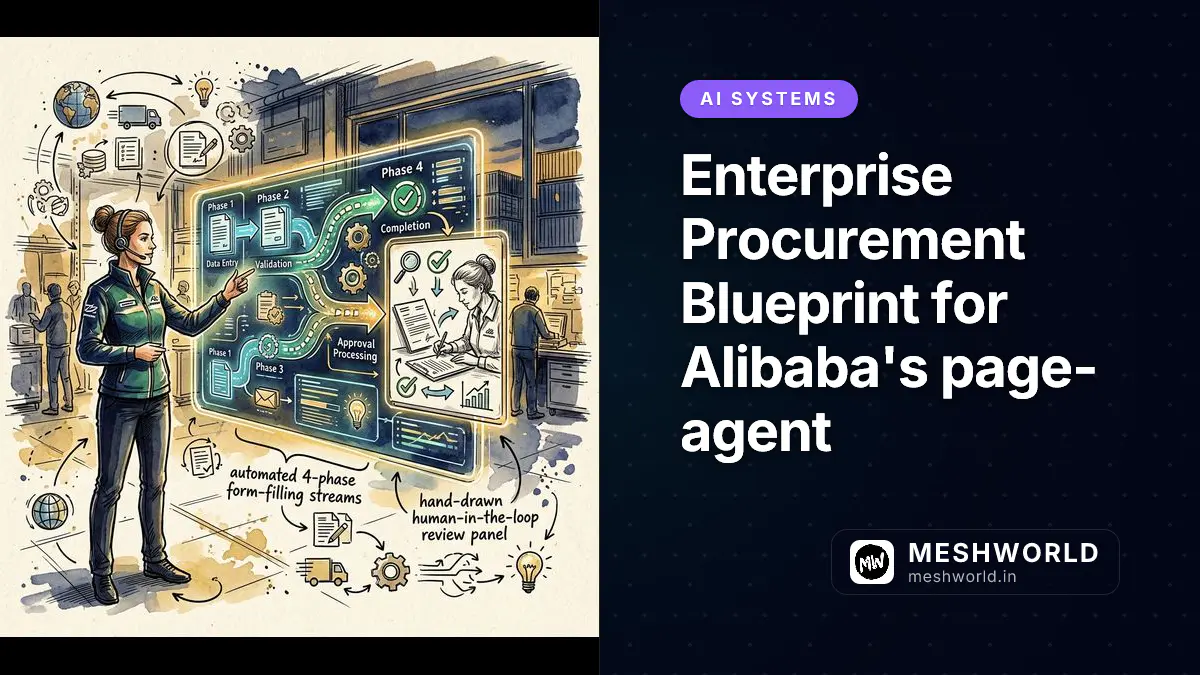
You structure a 4-phase enterprise page-agent rollout by guiding deployment through Sandbox Ergonomics, Secure API Proxy Isolation, PII Data Governance, and Production OpenTelemetry Monitoring.
Organizing enterprise adoption into distinct, gated deployment phases prevents premature production exposure. Each phase introduces specific operational validation gates, ensuring that software development teams, infrastructure engineers, and compliance officers align on performance thresholds before expanding agent access across workforce web portals.
flowchart LR
    Phase1[Phase 1: Sandbox & Selector Audit] --> Phase2[Phase 2: Zero-Trust Backend Proxy]
    Phase2 --> Phase3[Phase 3: Client PII Masking & HITL]
    Phase3 --> Phase4[Phase 4: OpenTelemetry SLA Tracking]
Phase 1 Sandbox Ergonomics: How Do You Test Selector Stability in Development?
You test selector stability in development by auditing DOM accessibility trees, adding persistent data-testid target attributes, and verifying element dehydration token counts across key enterprise portals.
In Phase 1, engineering teams evaluate target enterprise web portals (such as SAP, Salesforce, or Workday). Developers verify that critical interactive elements contain stable accessibility attributes (aria-label, data-testid, role), ensuring high agent execution accuracy during initial pilot testing.
Furthermore, pilot development teams capture sample DOM dehydration payloads across heavy data tables and form grids. By auditing dehydrated text outputs in sandbox environments, engineers identify unnecessary DOM subtrees and apply custom query filters to keep prompt contexts lean, fast, robust, and responsive.
Phase 2 Proxy Security: How Do You Enforce Zero-Trust Credential Isolation?
You enforce zero-trust credential isolation by building a server-side API proxy endpoint that injects secret LLM API keys and validates client authentication tokens before forwarding request payloads.
In Phase 2, security teams implement a zero-trust backend API proxy. The client-side page-agent module never holds raw model credentials. Instead, requests pass through an internal API gateway that verifies user authorization headers, applies IP rate limits, and appends secret environment variables.
Additionally, backend proxies enforce token budget limits per user session. If a runaway client-side automation loop attempts to issue repetitive model requests, the proxy automatically throttles incoming requests and returns rate-limit warnings to the client application.
Phase 3 PII Masking: How Do You Maintain GDPR and SOC2 Data Governance?
You maintain GDPR and SOC2 data governance by deploying client-side regex PII scrubbing middleware that redacts sensitive personal data before dehydrated DOM payloads leave the browser memory.
Phase 3 establishes data privacy safeguards. Before any dehydrated DOM payload leaves browser memory, client-side middleware redacts credit cards, social security numbers, employee emails, and authentication tokens:
// OpenTelemetry Middleware Tracing Snippet
import { trace } from "@opentelemetry/api";

const tracer = trace.getTracer("page-agent-enterprise");

export async function trackedAgentExecution(userPrompt: string) {
  return tracer.startActiveSpan("pageAgent.executeTask", async (span) => {
    try {
      span.setAttribute("agent.prompt", userPrompt);
      const result = await controller.execute(userPrompt);
      span.setStatus({ code: 1 }); // Success
      return result;
    } catch (error: any) {
      span.recordException(error);
      span.setStatus({ code: 2, message: error.message }); // Error
      throw error;
    } finally {
      span.end();
    }
  });
}
To satisfy SOC2 Type II audit trail requirements, client-side data masking operations emit cryptographic hashes of scrubbed payloads. Compliance auditors can verify that zero un-scrubbed personal information was transmitted to upstream LLM providers.
Phase 4 Production Telemetry: How Do You Track Agent SLAs with OpenTelemetry?
You track agent SLAs with OpenTelemetry by wrapping PageController execution calls inside distributed tracing spans that measure DOM dehydration latency, LLM response times, and step completion rates.
In Phase 4, platform operations teams deploy OpenTelemetry instrumentation across client endpoints. Operations dashboards track key performance indicators (KPIs), including:
- Step Completion SLA: Percentage of tasks executed successfully without fallback retries (Target: > 95%).
- Dehydration Latency: Time required to parse and compress the active DOM tree (Target: < 300ms).
- Upstream Proxy Response Time: End-to-end round-trip latency to the LLM endpoint (Target: < 1.5s).
- Target Selection Drift: Rate of element click retries caused by dynamic single-page application re-renders.
Financial ROI Model: What Are the Cost Savings Compared to Vision Fleets?
The financial ROI model demonstrates up to 92% total cost savings by replacing expensive server-side headless browser fleets and vision model tokens with lightweight in-page client execution.
Operating server-side visual browser fleets requires provisioning large GPU and CPU container clusters to render headless Chrome instances. In contrast, page-agent executes within existing client browser sessions, completely eliminating backend browser hosting expenses and container orchestration overheads.
Here is an annual cost comparison based on 100,000 monthly automation task executions across an enterprise workforce:
| Expense Category | Server-Side Vision Fleet (Browser-Use / Playwright) | In-Page Client Agent (Alibaba page-agent) | Annual Enterprise Savings |
|---|---|---|---|
| Server Infrastructure (EC2 / Docker) | $1,800 / month (Headless Containers) | $0 / month (Runs in Client Browser) | $21,600 / year |
| LLM Token Costs (100k Tasks) | $2,400 / month (15k Vision Tokens/step) | $300 / month (1.2k Text Tokens/step) | $25,200 / year |
| Engineering Maintenance | High (Broken container proxies & cookies) | Low (Self-contained in-page execution) | ~150 Dev Hours / year |
| Total Annual Cost | $50,400 / year | $3,600 / year | $46,800 / year (92.8% Savings) |
Enterprise Risk Mitigation & Procurement Review Standards
During formal procurement review panels, enterprise security compliance teams evaluate five primary operational risk dimensions before authorizing wide organizational deployment:
- Zero Credential Exposure: Confirm zero API keys exist in client JavaScript bundles or client-accessible storage.
- SOC2 Type II Audit Log: Ensure all outgoing dehydrated DOM payloads are logged to encrypted server audit storage for compliance inspection.
- HITL Safety Gates: Require manual human confirmation for financial transactions, wire transfers, or data deletion tasks.
- Vulnerability Mitigation: Ensure the client-side
page-agentpackage dependencies undergo automated daily Snyk or Dependabot security scanning. - Session Isolation: Guarantee that agent execution state is scoped strictly to the current active browser tab and destroyed upon tab closure.
Frequently Asked Questions
Is page-agent compliant with SOC2 Type II and HIPAA data standards?
Yes. Because page-agent supports local BYOLLM endpoints (like Ollama or vLLM) and client-side PII scrubbing, zero sensitive data leaves your secure infrastructure.
What happens if an enterprise portal updates its UI layout?
Because page-agent interprets semantic DOM text nodes dynamically rather than relying on fixed XPath selectors, minor UI updates do not break automation flows.
How quickly can a team complete the 4-phase procurement blueprint?
Most enterprise engineering teams complete the pilot sandbox and proxy rollout within 2 to 3 weeks.