
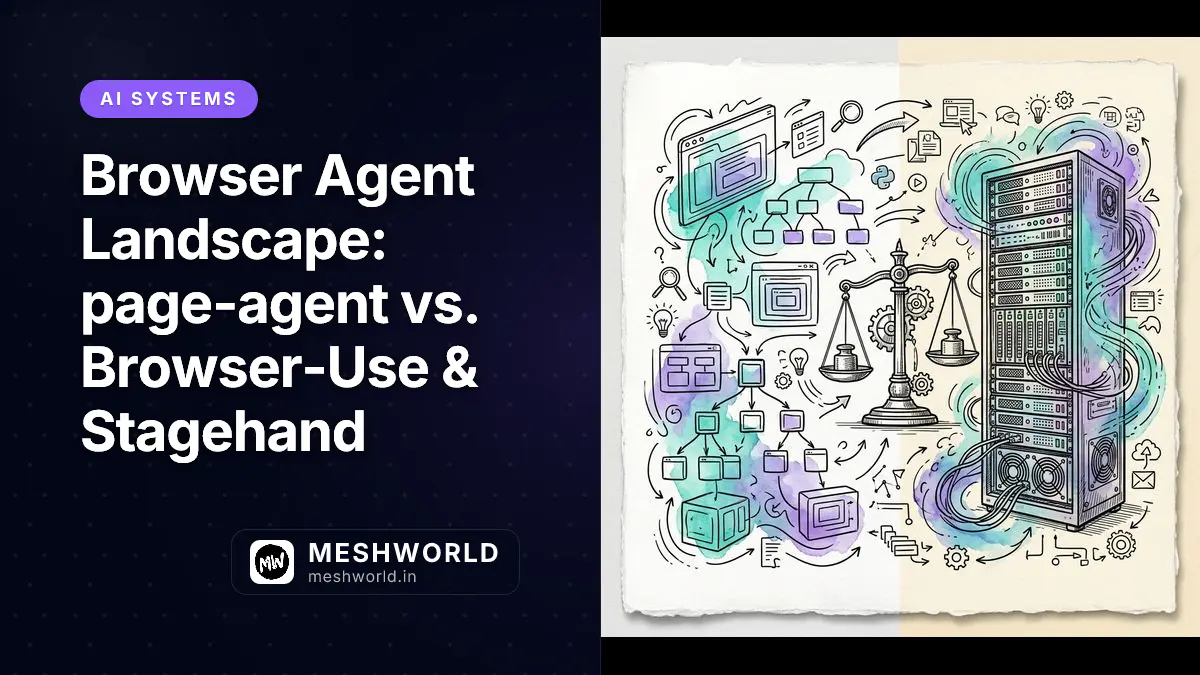
The ecosystem for browser-native AI automation has evolved into distinct architectural categories. Choosing the right framework depends on whether your application needs in-page copilot execution, background server-side web scraping, or visual computer-vision extraction.
Following our framework evaluation methodology from our autonomous AI agent comparative matrix, this article benchmarks Alibaba’s page-agent, Browser-Use, Stagehand, and Skyvern across 7 engineering dimensions.
Architectural Paradigms: How Do In-Page Agents Compare to External Headless Fleets?
In-page agents compare to external headless fleets by executing directly inside the user’s active browser tab using text DOM dehydration, whereas external headless fleets run standalone browser processes on server infrastructure using screenshot vision pipelines.
flowchart TD
    A[Browser Automation Requirement] --> B{Execution Environment}

    B -->|In-Page / User Active Tab| C[Alibaba page-agent]
    C --> C1[Client JS + DOM Dehydration]
    C1 --> C2[Lowest Token Cost & Fast Latency]

    B -->|Server-Side / Background Bot| D{Observation Engine}
    D -->|Hybrid DOM + Code| E[Stagehand TypeScript]
    D -->|Playwright + Vision| F[Browser-Use Python]
    D -->|Pure Vision / OCR| G[Skyvern]
Framework Deep Dive: What Are the Key Architectural Differences Across Modern Frameworks?
The key architectural differences across modern frameworks stem from their observation engine, execution context, session management model, and underlying language runtime:
- Alibaba
page-agent(In-Page Client JS): Operates inside host window memory. Uses text DOM dehydration to eliminate screenshot token costs and automatically inherits active user session cookies and local storage. - Browser-Use (Python + Playwright): Runs standalone headless Chrome instances via Python. Combines Playwright DOM trees with visual screenshot prompts for multi-page background scraping.
- Stagehand (TypeScript + Playwright): Designed for TypeScript developers wanting code-level control over Playwright primitives combined with LLM element selection heuristics.
- Skyvern (Python + Computer Vision): Uses computer vision and OCR to parse pixel rendering directly, ignoring DOM markup for legacy, non-semantic web portals.
Feature Matrix: How Do page-agent, Browser-Use, Stagehand, and Skyvern Compare?
Alibaba page-agent, Browser-Use, Stagehand, and Skyvern compare across core technical metrics as detailed in the following benchmark matrix:
| Feature Metric | Alibaba page-agent | Browser-Use | Stagehand | Skyvern |
|---|---|---|---|---|
| Primary Runtime | Client JavaScript (TS) | Python | TypeScript (Node) | Python |
| Execution Location | Active Browser Tab | External Headless Server | External Headless Server | External Headless Server |
| Observation Type | Text DOM Dehydration | Screenshot + DOM Tree | Hybrid DOM / Text | Pure Vision / OCR |
| Session Model | Automatic (Active Window) | Manual Cookies / Storage | Manual Cookies / Storage | Manual Cookies / Storage |
| Relative Token Cost | 1x (Lowest) | 10x – 15x | 5x – 8x | 15x – 25x |
| Infrastructure Needed | Zero (Runs in Browser) | Docker / Browser Fleet | Node.js Server Fleet | Docker / GPU Fleet |
| Best For | Embedded SaaS Copilots | Unattended Web Bots | E2E Testing & Scripts | Legacy Non-Semantic Portals |
Performance Benchmarks: Which Framework Delivers the Lowest Token Cost and Latency?
Alibaba page-agent delivers the lowest token cost and latency because text DOM dehydration consumes only 800 to 2,500 text tokens per step with 0.4s to 1.2s response times, compared to 12,000+ vision tokens and 4s+ latency for screenshot-based frameworks.
gantt
    title Single Action Step Latency Benchmark (Seconds)
    dateFormat  X
    axisFormat %s s

    section page-agent (Text DOM)
    DOM Dehydration & Token Dispatch :0, 1
    LLM Inference (800 tokens)        :1, 2

    section Stagehand (Hybrid)
    Playwright DOM Extract & Dispatch :0, 2
    LLM Inference (3,500 tokens)      :2, 4

    section Browser-Use (Vision)
    Screenshot Capture & Encoding    :0, 2
    Vision LLM Inference (15k tokens) :2, 6
Architectural Decision Tree: How Should Engineering Teams Select a Browser Agent?
Engineering teams should select a browser agent based on deployment goals: choose page-agent for in-app SaaS copilots, Browser-Use for unattended background web scraping, Stagehand for TypeScript Playwright pipelines, and Skyvern for legacy non-semantic portals.
flowchart TD
    Start[Evaluate Web Automation Task] --> Q1{Is the task embedded in a user active tab?}
    Q1 -->|Yes| UsePageAgent[Choose Alibaba page-agent]
    Q1 -->|No| Q2{Does the target web app have accessible HTML markup?}

    Q2 -->|Yes, Node/TS Pipeline| UseStagehand[Choose Stagehand]
    Q2 -->|Yes, Python Scraping Bot| UseBrowserUse[Choose Browser-Use]
    Q2 -->|No, Canvas/Legacy Non-Semantic| UseSkyvern[Choose Skyvern]
Frequently Asked Questions
Can page-agent and Browser-Use be combined in a single project?
Yes. Many enterprise teams use page-agent for in-app interactive copilots and Browser-Use for server-side background data ingestion.
Which framework is easiest to deploy without server infrastructure?
Alibaba page-agent requires zero backend container fleets because execution runs entirely inside the user’s client browser.
How does Stagehand differ from raw Playwright?
Stagehand wraps Playwright with AI-driven element selection heuristics (page.act(), page.extract()), eliminating brittle hardcoded CSS selectors.