
If you run a website with ads, you’re a publisher. If you pay to put ads on other people’s sites, you’re an advertiser. Simple enough — except some publishers play both roles. They buy cheap traffic (acting as an advertiser), route it to their own site, and try to earn more from display ads than they paid for the clicks. That’s traffic arbitrage.
This guide breaks down how publishers and advertisers differ, whether the arbitrage math works, and why most people who try it lose their ad accounts.
Publisher vs. Advertiser: What’s the Difference?
Think of it as two sides of the same transaction. A publisher has ad space to sell. An advertiser wants to buy that space to reach people. You can be both — lots of businesses are — but the metrics and tools are completely different depending on which hat you’re wearing.
The Publisher
You own a blog, a web tool, or a mobile app. You have visitors. You put ads in front of them. Your goal is to make as much money as possible from each visit. You use platforms like AdSense, Mediavine, or Raptive. Your key number is RPM (Revenue Per Mille) — how much you earn per 1,000 pageviews.
The Advertiser
You have a product or service to sell. You pay to put your ads on publisher sites to bring in customers. You use Google Ads, Meta Ads, or Taboola. Your key numbers are CPC (Cost Per Click), CPA (Cost Per Acquisition), and ROAS (Return on Ad Spend).
| Operational Factor | The Publisher | The Advertiser |
|---|---|---|
| Primary Objective | Maximize yield per pageview | Minimize cost per acquisition |
| Monetization Tool | Raptive, Mediavine, AdSense, Ezoic | Google Ads, Meta Ads, Taboola, Outbrain |
| Key Metric | Session RPM / Page RPM | CPA, CPC, Conversion Rate, ROAS |
| Revenue Stream | Earnings paid out by ad networks | Direct product sales or lead capture |
What is Traffic Arbitrage and How Does it Work?
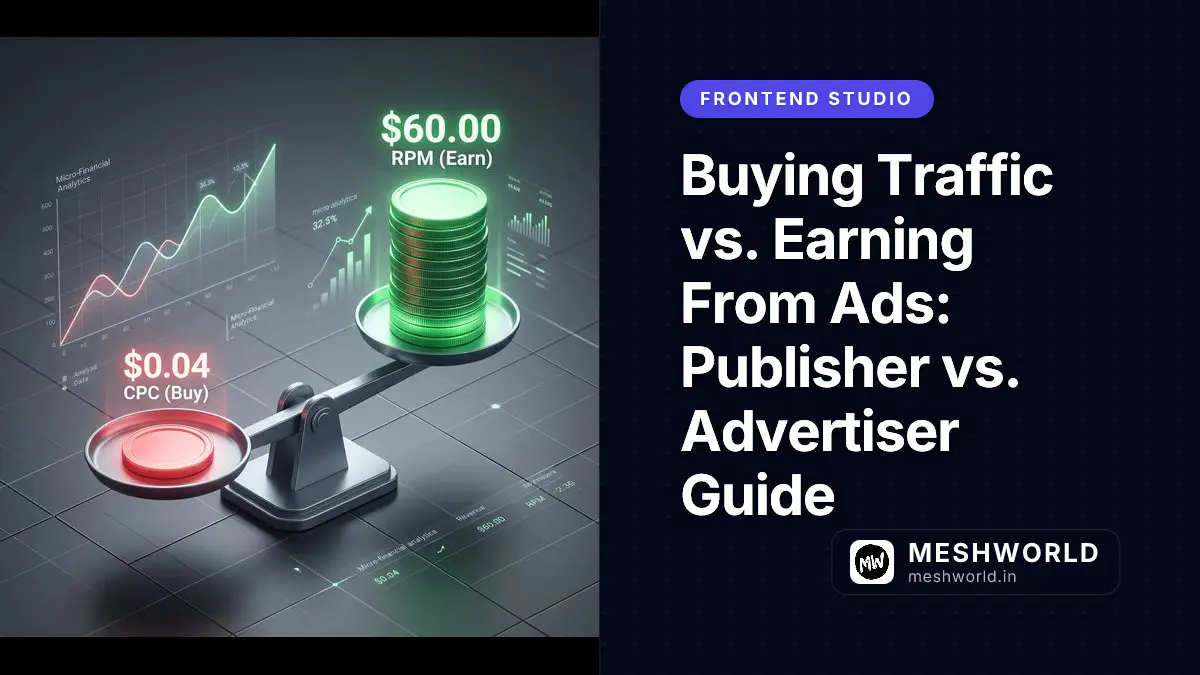
Traffic arbitrage is a business model where a publisher acts as an advertiser to purchase cheap traffic, then routes those visitors to their own website to monetize them at a higher display ad rate.
graph LR
    A["Paid Traffic Sources (Meta, Taboola)"] -->|"$0.04 Cost Per Click (CPC)"| B["Publisher Website"]
    B -->|"$45.00 Session RPM"| C["Ad Networks (Raptive, Mediavine)"]
    C -->|"$0.045 Earned Per Visitor"| D["Net Arbitrage Profit: $0.005 / Visit"]
Arbitrage works if your earnings per visitor beat your cost per click. Here’s how the numbers play out:
-
Acquisition Cost (CPC): You spend $500 to buy 10,000 clicks from native ad networks. That’s $0.05 per click.
-
Page Yield (RPM): Your landing page is optimized with multiple ads. Session RPM is $60.00, meaning each 1,000 visitors earns $60 — that’s $0.06 per visitor.
-
The Spread: Your profit is the difference:
- Net Profit = (10,000 visitors × $0.06) − $500.00 = $100.00
Sounds good on paper. In practice, sustaining this means packing your page with ads, building slideshows, and chasing viral content to maximize ad impressions per session. It’s exhausting and fragile.
The Risks of Buying Traffic
The math looks clean. The reality is not. Ad networks have spent years building systems to detect and block exactly this kind of behavior.
1. IVT Suspensions
Raptive and Mediavine have zero tolerance for low-quality traffic. Paid native ads from second-tier platforms are full of bots, click farms, and accidental clicks. These networks use real-time monitoring tools (Human Security, IAS) to catch it. If your site shows elevated invalid traffic (IVT), your account gets terminated and your earnings refunded to advertisers. Game over.
2. Smart Pricing
Google uses “Smart Pricing” algorithms. If your traffic doesn’t convert — high bounce rates, low engagement — advertisers pay less for your inventory. Your RPM drops, and suddenly the arbitrage math flips negative. You’re paying more for traffic than it earns.
[!WARNING] Cheap pop-under networks, click exchanges, and unverified social promotions will get you flagged for “encouraging accidental clicks” or “formatting content to mimic ads.” Google AdSense does not mess around.
The Better Path: Organic Traffic
Instead of gambling on arbitrage, build an audience that comes to you because your content is worth reading. It’s slower, but it doesn’t get your account banned.
-
Write for commercial intent keywords: Advertisers pay more for clicks from people searching for things to buy. Cloud infrastructure, financial tools, enterprise software — those categories have high CPCs.
-
Go after long-tail searches: Broad terms are crowded. Specific developer questions have lower competition and attract readers who actually scroll past the fold, which means more ad views.
-
Upgrade your ad network as you grow: Start with AdSense, then move to premium networks with header bidding. The Best Ad Networks for Publishers guide has the traffic requirements and revenue comparisons.
Frequently Asked Questions
What’s the difference between CPM and RPM?
CPM is what advertisers pay per 1,000 impressions. RPM is what publishers earn per 1,000 pageviews — combining all ad units on the page. Two sides of the same coin.
Is traffic arbitrage legal?
Technically yes. But most premium ad networks prohibit paid traffic as your primary source. They do this to protect advertisers from low-quality or artificial traffic.
How much organic traffic do I need for premium ad networks?
Monumetric needs 10,000 monthly pageviews. Mediavine needs 50,000 monthly sessions. Raptive needs 100,000 monthly pageviews.
Why is search traffic worth more?
Search traffic has intent. Someone searching “best cloud hosting for startups” is closer to buying than someone scrolling Facebook. Advertisers pay more for that.