

MongoDB is a document-oriented NoSQL database designed for high-volume data storage and scalability. The name is derived from the word humongous, reflecting its ability to handle massive datasets with ease.
Unlike traditional RDBMS, MongoDB uses a flexible, JSON-like format called BSON (Binary JSON), which allows for dynamic schemas and efficient storage.
1. Core Architecture of MongoDB
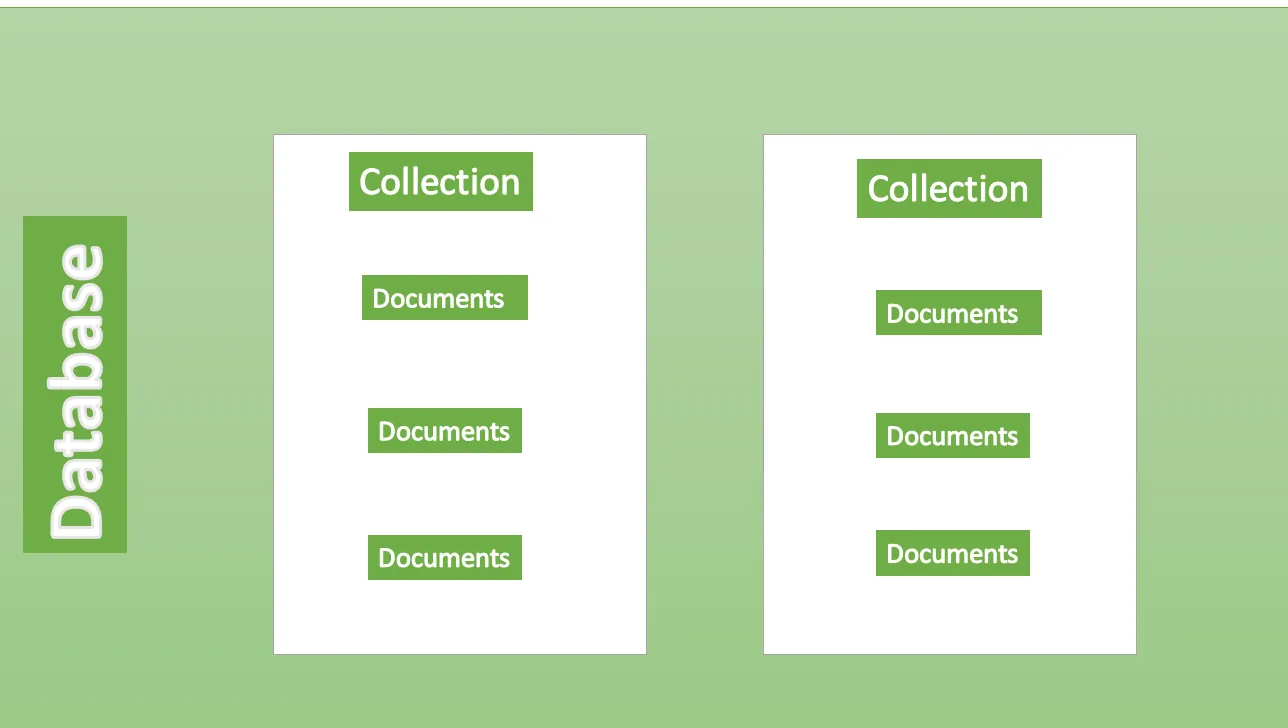
To understand MongoDB, we must first look at its fundamental building blocks:
Database
A physical container for data. A single MongoDB server can host multiple databases, each acting as a separate environment.
Collection
A grouping of MongoDB documents. Think of this as the Table equivalent in RDBMS. However, collections do not enforce a fixed schema, meaning documents in the same collection can have different structures.
Document
A set of key-value pairs—the basic unit of data in MongoDB. A record is called a document, and it is stored in BSON format.
2. Why Choose MongoDB?
MongoDB is often the preferred choice for modern applications due to its flexibility and performance characteristics:
- Document-Oriented: No complex relational joins. Data that is accessed together is stored together.
- Indexing: Support for secondary indexes to optimize search performance.
- High Availability: Built-in replication and automated failover.
- Horizontal Scalability: Support for Sharding, allowing you to distribute data across multiple servers.
3. MongoDB vs. MySQL: Industrial Comparison
| Feature | MySQL (RDBMS) | MongoDB (NoSQL) |
|---|---|---|
| Data Model | Tabular (Rows & Columns) | Document-oriented (BSON) |
| Schema | Rigid / Fixed | Dynamic / Flexible |
| Query Language | SQL | MongoDB Query Language (MQL) |
| Joins | Native support | Not recommended (use Embedding) |
| Scalability | Primarily Vertical | Native Horizontal (Sharding) |
4. Summary
MongoDB represents a significant shift from the rigid structures of SQL. It empowers developers to build and iterate faster by allowing the database schema to evolve alongside the application code.
Hope you found this introduction helpful! Stay tuned for more deep dives into the NoSQL laboratory.
Happy coding!