
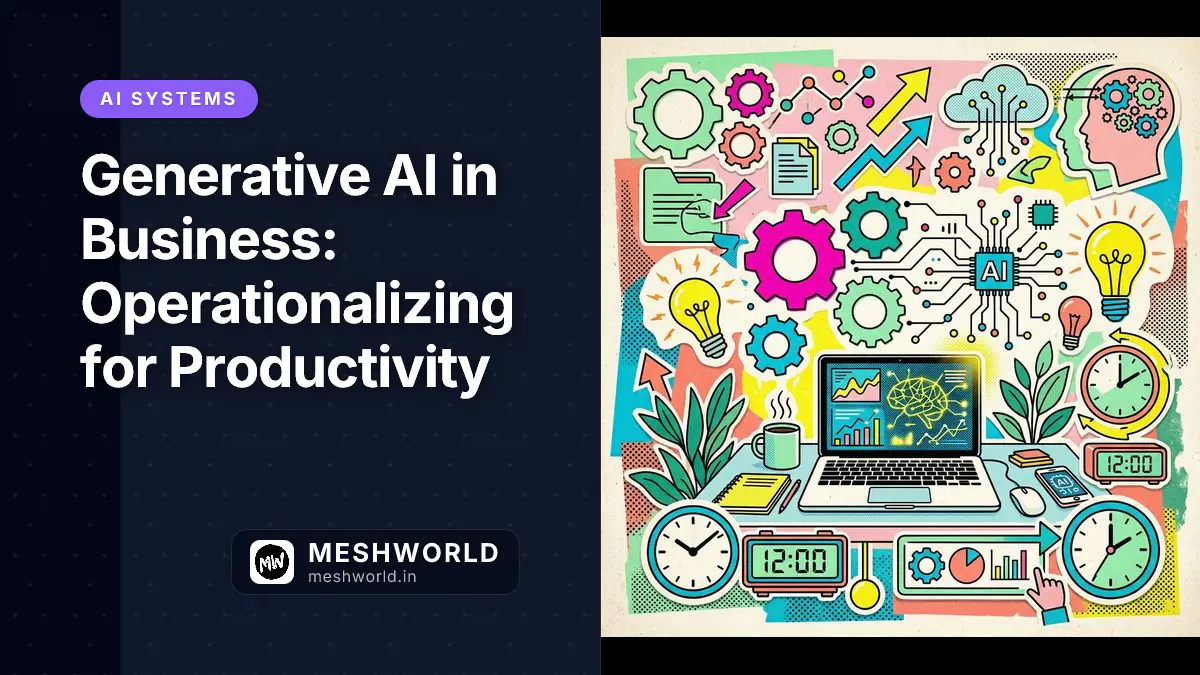
The era of AI pilots is over. The era of AI operations has begun.
I’ve been watching this shift happen in real-time with clients across industries. In 2023, fewer than 5% of enterprises had tested or deployed GenAI-enabled applications. Going into 2026, that figure has surged past 80%. The question everyone asks me isn’t whether to adopt generative AI anymore — it’s how to make it actually pay off.
Manjeet Rege, director of the University of St. Thomas Center for Applied AI, put it perfectly: “Gone are the days when executives ask, ‘Should we try this? Should we test this?’ Now they’re asking, ‘How do we run this reliably for hundreds of users?’”
This article examines how companies across industries are deploying generative AI for productivity in 2026 — the use cases delivering measurable results, the ROI picture, the shift toward agentic AI, and the challenges organizations face in scaling beyond pilots.
Part I: The State of Generative AI Adoption in 2026
The Numbers Tell the Story
Enterprise generative AI spending hit $37 billion in 2025, more than tripling from the year before. Gartner projects total worldwide AI spending will top $2.5 trillion in 2026. The enterprise generative AI market alone is growing at a compound annual growth rate of 40%, from $4.66 billion in 2025 to $6.52 billion in 2026.
Adoption metrics reveal a dramatic acceleration:
- More than 80% of enterprises have tested or deployed GenAI-enabled applications
- 78% of companies now use generative AI, with 71% using it “regularly” in at least one business function
- 44% of enterprises are now actively deploying generative AI models in production
- 40% of professionals say their organizations now use GenAI, up from 22% the previous year
The Adoption Gap: Leaders vs. Laggards
Not all organizations are moving at the same pace. Cyberhaven Labs’ 2026 AI Adoption & Risk Report reveals a stark “AI Adoption Gap”:
- Frontier organizations are utilizing over 300 GenAI tools, adopting them at nearly 6x the rate of the average company
- In leading organizations, 71.4% of employees use GenAI, compared to just 2.5% in cautious enterprises
- Technology (40.5%), Pharmaceuticals (33%), and Financial Services (28.7%) are the most aggressive adopters
Large enterprises are pulling ahead. A 2026 study found that 70.4% of small businesses do not have a roadmap for adopting generative AI, compared to 54.4% of large companies. B2B leaders — 44% of whom have fully implemented generative AI — are twice as likely as laggards (22%) to have done so.
The Shift in Executive Mindset
The experimentation phase of 2024 and 2025 is rapidly giving way to a more disciplined, outcome-oriented era. Organizations are now linking AI projects to clear KPIs such as revenue growth, productivity, and cost reduction.
Boards that tolerated AI spend as an R&D line item are growing impatient. Executive leadership is shrinking the window for ROI from years to quarters. As one analysis put it: “The capital has moved. The returns have not.”
Part II: Generative AI Use Cases Driving Productivity in 2026
Generative AI has evolved from isolated, experimental deployments to production-ready implementations capable of handling enterprise-wide workflows. The technology is now embedded into core enterprise software, internal workflows, customer-facing platforms, analytics systems, and product development pipelines.
1. Content Generation and Marketing
Content creation remains the most widely adopted GenAI use case, with marketing and product teams leveraging AI to draft blogs, write emails, produce ad copy, and generate product descriptions.
Productivity Impact: Agencies report 4-5x productivity improvements for AI-assisted content.
Real-World Example: At McKinsey, AI has allowed consultants to pare back their reliance on PowerPoint dramatically. Kate Smaje, McKinsey’s Global Leader for technology and AI, reported that usage of PowerPoint dropped massively within months as employees began vibe-coding with AI tools. One McKinsey consultant created an AI-assisted website that acts as a central project hub, replacing the traditional slide-deck approach and saving the team significant time.
2. Software Development and Coding

Three out of four large organizations have now piloted or scaled generative AI for software development. Nearly 50% of developers now use coding assistants like Cursor and GitHub Copilot, with usage in frontier companies reaching 90%.
The Vibe Coding Phenomenon: “Vibe coding” — where non-developers generate applications through natural language prompts — has upended traditional development processes. 63% of those using vibe coding tools are non-developers. However, the productivity picture is nuanced: a coding test found that engineers using AI vibe coding tools spent 20% more time prompting models and reviewing outputs, making them less productive overall than non-vibe coding participants.
Building on the developer sentiments we analyzed in The Trust Crisis in AI Coding: 84% Use It, 3% Trust It, this surge in adoption highlights both massive efficiency gains and a critical oversight in production assurance.
Security Concerns: In a study of over 100 LLMs, 45% of AI-generated code samples surfaced security vulnerabilities. Only about 33% of developers say they would feel very confident using vibe coding tools to build and maintain business-critical apps.
3. Customer Service and Support
Generative AI chatbots and support agents are now standard across industries. Early adopters are moving beyond simple FAQ bots to systems with secure, real-time access to booking data and customer histories.
Real-World Example: easyJet holidays won an AI award for its AI-powered chatbot, launched in 2025, which delivers personalized responses to customers at scale. Länsförsäkringar, a large mutual insurance company, is exploring how generative AI can support customer service in a regulated environment with attention to governance and service quality.
Productivity Impact: An insurance team using AI agents closed claims 60% faster.
4. Sales and Revenue Operations
Sales teams are using AI to analyze deals, predict customer behavior, and generate forecasts. In B2B environments, AI algorithms predict customer behavior, helping businesses make informed decisions about logistics, inventory management, and personalized marketing strategies.
Real-World Example: Natural Intelligence cut manual onboarding from 10 days to a fully automated process using specialized Gemini-powered agents, reaching an 80% customer retention rate.
Generative AI tools now rank among the top five channels buyers use when researching suppliers, alongside supplier websites, web search, and video conferencing.
5. Knowledge Management and Institutional Memory
Perhaps one of the most transformative use cases is the application of generative AI to preserve and access institutional knowledge.
Real-World Example: Forze Hydrogen Racing, a student motorsport team building hydrogen-powered race cars, faced a 100% workforce turnover every year, onboarding 50 to 60 new student engineers. After 18 years of continuous improvements, the team’s technical DNA — including specifications, CAD drawings, telemetry, and operational guidelines — had become siloed across thousands of documents.
Randstad Digital developed an AI agent called Forze Mirate using Google Cloud’s Gemini Enterprise. The solution enables engineers to query 18 years of engineering history in natural language, receiving contextualized, role-specific answers with citations to original documents.
Results:
- Reduced time-to-productivity for new engineers by up to three times
- Reduced reliance on alumni and lead engineers by 80%
- Improved institutional knowledge retention by 50%
6. Financial Services and Investment Analysis
OpenAI’s June 2026 “Intelligence at Work” event introduced Codex workflow plugins for stock research, investment banking roadshows, and creative design. The platform now covers data analysis, creative design, sales, product design, stock investment, and investment banking — six job functions with specialized workflow plugins.
7. Product Design and Innovation
Generative AI is accelerating product design cycles. Companies are training custom AI models on proprietary assets to enable rapid experimentation.
Real-World Example: Coach (Tapestry) embraced generative AI through Adobe Firefly, training it with their own proprietary assets to create a custom model. This allows product designers to experiment with new concepts and take advantage of cultural trends while maintaining brand consistency.
8. Supply Chain and Operations
B2B wholesale businesses are leveraging generative AI to streamline operations, reduce costs, and deliver superior value through efficient and personalized e-commerce experiences. AI algorithms predict customer behavior, helping businesses make informed decisions about logistics and inventory management.
Part III: The Agentic AI Revolution
From Copilot to Coworker
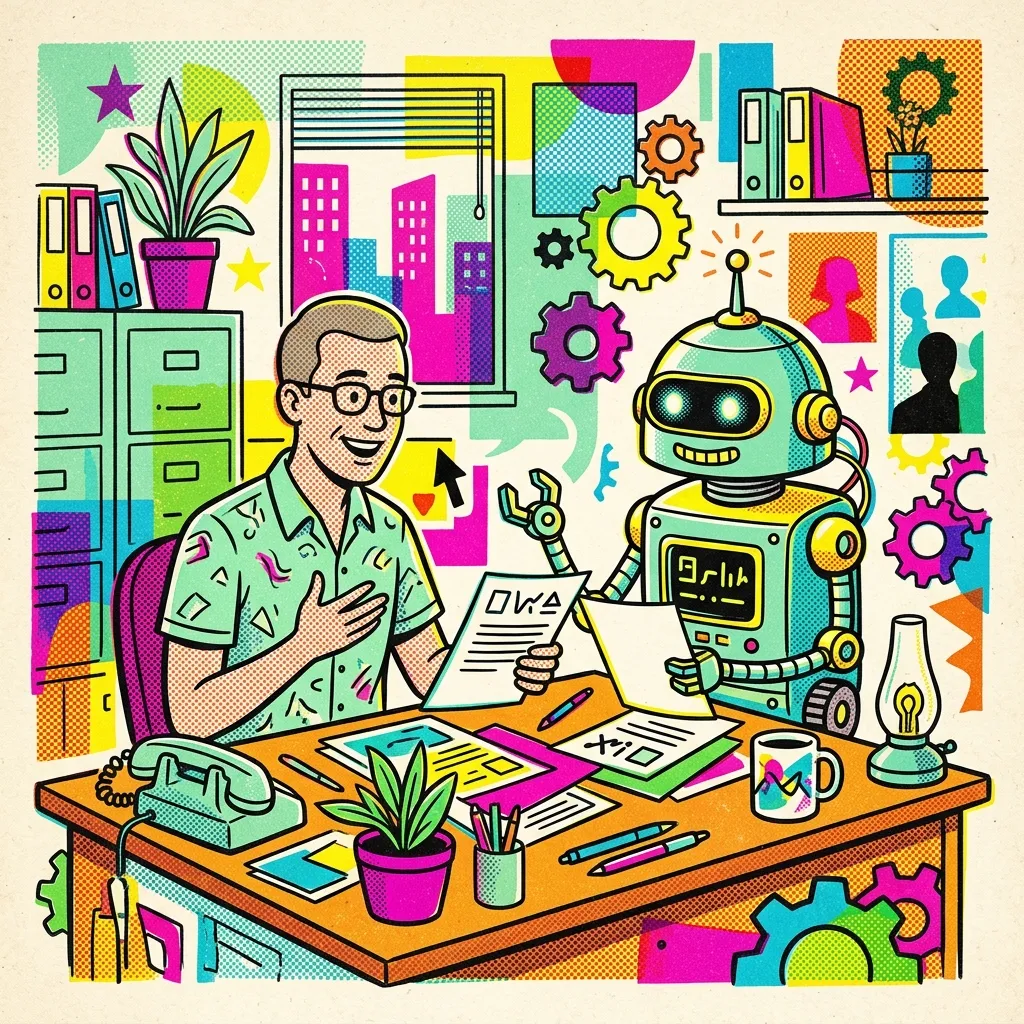
The defining enterprise AI trend of 2026 is the shift from “copilot” (AI assisting a human) to “agent” (AI executing multi-step workflows autonomously).
Gartner predicts 40% of enterprise applications will integrate task-specific AI agents by the end of 2026, up from less than 5% in 2025.
The numbers bear this out:
- 62% of businesses have begun experimenting with deploying AI agents
- 23% are scaling an agentic AI system within their enterprise
- 32% of early adopters already have agentic solutions in production
- 44% of organizations with multiple GenAI use cases in production are already using agentic AI
The Agent Ecosystem Expands
June 2026 saw a flurry of major agentic AI launches:
Microsoft Copilot Cowork: Launched June 16, 2026, this AI “agent” can independently carry out office tasks like drafting documents, building spreadsheets, and sending emails. Microsoft moved to a pay-as-you-go pricing model — the first major pricing change in two decades. One customer used it to compare nearly 4,000 documents in a matter of hours.
Meta Business Agent: Built on Llama 5, this agent handles scheduling, expense reporting, customer support, and internal data analysis without requiring users to switch between applications.
Adobe CX Enterprise Coworker: Acts as a “central intelligence layer” for teams by synthesizing insights from Adobe and third-party applications, coordinating AI agents and workflows across analytics, content creation, and customer journey orchestration.
The Architecture of Agentic AI
If 2024 was the year of Generative AI and 2025 the year of agents, 2026 is becoming the year of Stacked AI: multiple specialized agents wrapped around data products and orchestrated into workflows that operations genuinely depend on.
The value in 2026 lies in agentic systems — specialized AI agents that communicate through Managed Context Protocols (MCP). The expertise is shifting from prompt engineering to architectural orchestration. Leaders should stop asking “Which model is best?” and start asking “Which system architecture delivers the outcome with the least amount of friction?”
Part IV: The ROI Reality
The Good News: Positive Returns Are Real

Despite skepticism, the data shows that generative AI is delivering returns:
- 92% of early adopters report a positive return on their GenAI investments
- 75% of C-level respondents for nontechnical business organizations report a positive, quantified ROI
- Organizations that quantified their ROI report earning $1.49 for every $1 invested
- Senior executives expect up to a 47% return on agentic investments in the next 12 months
The Bad News: The Gap Between Pilots and Scale
The positive headlines obscure a deeper challenge. McKinsey reports that while nearly eight in 10 companies use generative AI, nearly the same proportion report no measurable impact to the bottom line.
IBM’s CEO study, released around Think 2026, found that only 25% of enterprise AI initiatives are delivering expected ROI, and just 16% have scaled enterprise-wide. Techaisle’s research confirms the same gap: midmarket organizations plan a 27% average increase in GenAI spending for 2026, yet 45% of mid-sized firms remain stuck in pilot purgatory, unable to move workloads into production.
Deloitte’s 2026 “State of AI in the Enterprise” report, surveying 3,235 director-to-C-suite leaders, found that 66% report productivity gains from AI but only 20% report revenue growth, and only 34% are using AI to deeply transform products or processes.
The ROI Shift: From Soft Metrics to Hard P&L
Enterprise buyers have shifted their ROI focus from “soft” efficiency to measurable top-line and bottom-line impact. Productivity gains, the default justification for GenAI investments throughout 2024 and 2025, fell from 23.8% to 18.0% as the number one ROI metric. In its place, CFOs are demanding hard P&L accountability.
According to PwC’s 2026 Global CEO Survey, only 12% of CEOs report that AI has delivered both cost savings and revenue gains so far.
Why the Gap? The Operationalization Challenge
IBM’s central claim at Think 2026 is that enterprise AI failures are not model problems — they are architecture problems. Models are commodified. Inference costs will continue to fall. What organizations cannot buy off the shelf is the operating layer that lets agents act on connected data inside a governed infrastructure, with auditable outcomes.
As one analysis put it: “The enterprises pulling ahead are not deploying more AI. They are redesigning how their business operates.”
Part V: Challenges and Barriers to Scale
1. Data Quality and Quantity
The number one challenge cited by organizations is data quality and quantity (40% of respondents). GenAI systems require high-quality, well-structured data to deliver reliable outputs.
2. Employee Skills and Talent
Employee expertise and skills are the second biggest barrier (35% of respondents). For mid-sized companies, talent is an even bigger challenge: 43% cited it as a problem, compared to 34% of enterprise respondents.
3. Integration with Legacy Systems
Integration with existing or legacy systems is cited by 31% of organizations. Generative AI must work alongside decades-old infrastructure, creating complex technical and organizational challenges.
4. Security and Governance
82% of the top 100 most-used GenAI SaaS applications are classified as “medium” to “critical” risk. One-third of employees access AI tools via personal accounts, including 58% of Claude users and 60% of Perplexity users. Chinese open-weight models like DeepSeek and Qwen now account for 50% of all endpoint-based AI usage.
39.7% of all AI interactions involve sensitive data, meaning the average employee inputs proprietary information into AI once every three days. The 2026 AI Adoption & Risk Report warns that “frontier enterprises deploy hundreds of tools while security governance struggles to keep pace.”
This security gap isn’t limited to employee endpoints. As we detailed in our analysis of OpenClaw Alternatives 2026: Stop Risking Your Production Credentials, hosting autonomous agents on unverified environments exposes critical API keys and database credentials to substantial security risks.
5. Cost Management
The soaring cost of AI is forcing new pricing models. Microsoft’s move to pay-as-you-go for Copilot Cowork was prompted by the reality that running AI systems demands vastly more computing power than search engines or chatbots. The output tokens for a top-line model like Gemini 3 Pro are 25 times more expensive than the high-speed Gemini 3 Flash.
Organizations are responding by using high-intelligence models for logic and reasoning while swapping in distilled, cost-efficient models for high-volume tasks like summarization.
Part VI: Sector-Specific Adoption
Technology
The most aggressive adopters, with 40.5% of organizations in the sector using GenAI. Tech companies are leveraging AI for software development, customer support, and internal productivity.
Pharmaceuticals
33% adoption. Pharmaceutical companies like Sanofi are building their own AI ecosystems. Sanofi launched an internally developed generative AI companion called Concierge, which debuted in October 2024 and is now used by 60,000 employees — about 80% of the total workforce.
Financial Services
28.7% adoption. Financial institutions are using generative AI for fraud detection, customer service, investment analysis, and risk assessment.
B2B and Industrial
Leading B2B firms are twice as likely as laggards to have fully implemented generative AI capabilities. Global payments solutions provider BPC has been experimenting with generative AI to drive efficiencies across developer and customer service workflows.
Part VII: The Future — What’s Next?
2026: The Year of Stacked AI
As PA Consulting notes: “If 2024 was the year of Generative AI and 2025 the year of agents, 2026 will start to become the year of Stacked AI: multiple specialized agents wrapped around data products and orchestrated into workflows, that operations genuinely depend on, and would miss if switched off.”
The Operating Model Shift
McKinsey’s 2026 research reveals that some enterprise functions will evolve into “fusion organizations” where a small number of practitioners manage hundreds of AI agents, achieving theoretical productivity 20 times current levels.
The Abstraction of the Model Layer
Business leaders will stop focusing on which specific LLM they are using. Just as developers today don’t ask about the specific instruction set of a CPU, the value in 2026 lies in agentic systems and architectural orchestration, not individual models.
Generative AI Becomes Invisible
“GenAI is dissolving into the enterprise stack,” said Manjeet Rege. “Users will access it through ERP forms and CRM workflows, supply chain screens, ticketing systems and not by going to a GenAI tool. It is becoming like electricity. You don’t see it, you use it. You use what’s built on top of it.”
The Service as Software Paradigm
Sophisticated organizations are looking at AI not as a tool but as a way to perform the functions of a role. The goal is to transition from Software as a Service (SaaS) to Service as Software — automating job functions and unifying interfaces to reduce toil.
Key Takeaways
| Metric | Data Point |
|---|---|
| Enterprise GenAI spending (2025) | $37 billion |
| Enterprises using GenAI (2026) | 80%+ |
| Companies reporting positive ROI | 92% of early adopters |
| ROI per dollar invested | $1.49 |
| Enterprises scaling AI enterprise-wide | 16% |
| Organizations stuck in pilot purgatory | 45% of mid-sized firms |
| Developers using coding assistants | 50% (90% in frontier companies) |
| Organizations with agentic solutions in production | 32% |
| AI interactions involving sensitive data | 39.7% |
What to Read Next
- The Dark Side of AI: Bias, Privacy, and Security Risks — An in-depth analysis of algorithmic bias, data privacy threats, and security vulnerabilities in enterprise AI deployments.
- AI Agent Security: Protecting the New Perimeter — A detailed analysis of securing autonomous agent integrations as agentic AI goes mainstream.
- What You Should Never Paste Into AI Tools at Work — A practical guide to maintaining data privacy in enterprise workflows.