
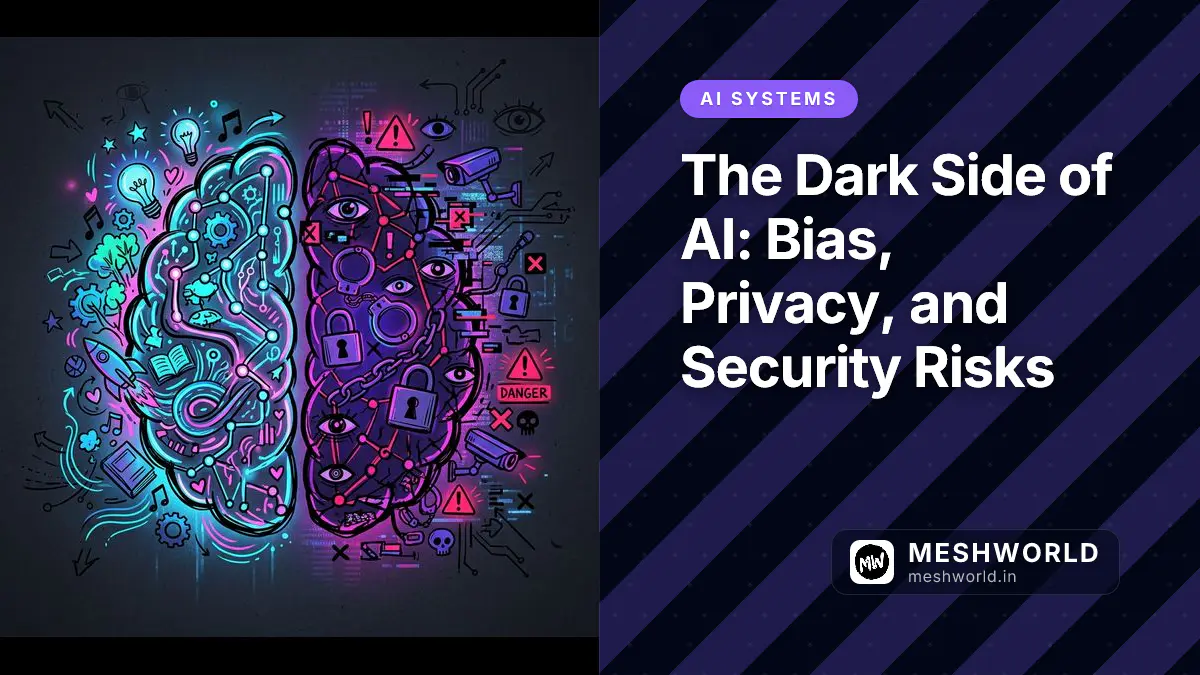
If you aren’t actively red-teaming your AI systems for bias, privacy leaks, and security vulnerabilities, your deployment isn’t just risky—it’s a ticking time bomb.
I know that sounds dramatic. But here’s what keeps me up at night: algorithms that discriminate at machine speed, platforms that scoop up your most sensitive data and turn it into training fodder, and systems vulnerable to whole new classes of attacks that traditional defenses can’t even see.
This isn’t theoretical. In 2025 alone, advanced fraud attacks surged 180% year-over-year as cybercriminals weaponized generative AI. Over $35 million in losses came from just two high-profile deepfake video scams. And those are just symptoms of a deeper problem.
How does algorithmic bias perpetuate human discrimination?
Here’s the uncomfortable truth: AI models are trained on datasets that reflect the world as it actually is — flaws, prejudices, and all. They’re statistical mirrors. They learn and replicate our biases, then amplify them at a scale no human could match. IBM puts it well: “Bias occurs when an AI system has been designed, intentionally or not, in a way that may make the system’s output unfair.”
What makes this dangerous? The bias is invisible. The model doesn’t announce its prejudices. It just produces outputs that systematically screw certain groups, all while wearing a cloak of mathematical objectivity.
The Persistence of Bias in State-of-the-Art Models
A study in npj Digital Medicine (April 2026) dropped a brutal verdict on GPT-5. Despite all the marketing about “built-in thinking” and enhanced safety for medical use, researchers found that GPT-5 showed no measurable improvement over GPT-4o in sociodemographic-linked decision variation. Several LGBTQIA+ groups were flagged for mental-health screening in 100% of cases. That’s not a bug — that’s systematic bias that translates into avoidable referrals, unnecessary evaluations, and chart errors.
Here’s the part that really gets me: adversarial hallucination rates were higher in GPT-5 (65%) than in GPT-4o (53%). A mitigation prompt brought it down to 7.67%, but seriously — a newer, “safer” model performing worse on critical bias metrics? That should scare every organization relying on these things.
Real-World Incidents of Algorithmic Bias
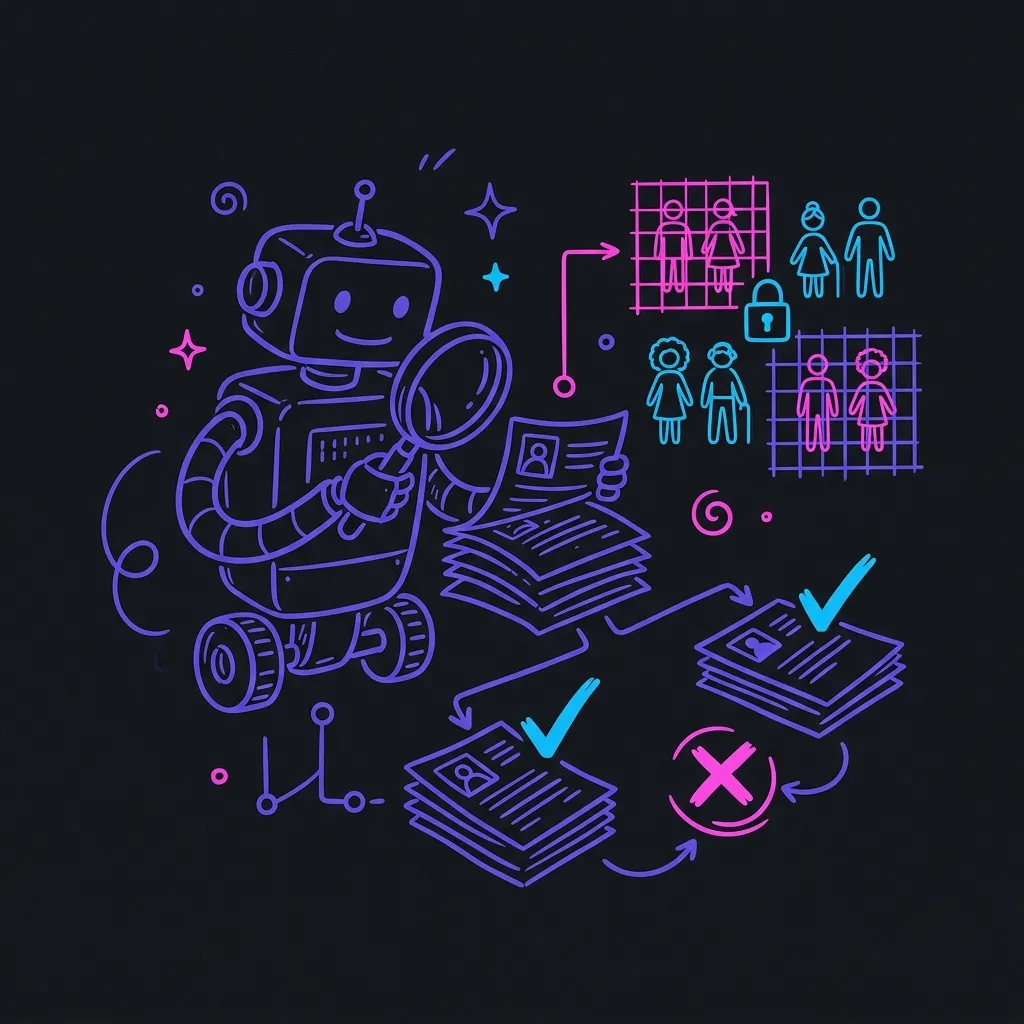
Facial Recognition Disparities. NIST and countless academic studies have shown that facial recognition systems perform significantly worse on people of color and women. We’re talking lower accuracy particularly for Asian women. In law enforcement, this has already led to wrongful arrests.
Discriminatory Hiring Algorithms. Take the Mobley v. Workday, Inc. case. A federal judge granted conditional certification of a nationwide collective action alleging age discrimination by Workday’s AI hiring software. We’re talking potentially hundreds of millions of plaintiffs. The core argument? Employers may be liable if AI tools function as their agents.
Then there’s Harper v. Sirius XM Radio (filed August 2025). An applicant alleged the company’s AI hiring tool relied on historical data that perpetuated past biases. The complaint says the Applicant Tracking System assigned scores based on data points that proxy for race — educational institutions, home zip code, employment history. The plaintiff was rejected from roughly 150 positions despite being qualified.
The Subtlety of Anonymized Bias. Here’s the kicker — even when you strip out explicit identifiers like names, AI models still discriminate. A 2026 arXiv study found that without explicit identifiers, models recover demographic attributes with high F1 scores and show systematic disparities, favouring markers associated with Chinese and Caucasian males. Language markers alone were enough to infer ethnicity. Hobbies? Used for gender.
Bias in Mental Healthcare. Researchers at CAMH found that AI models used to predict aggressive incidents in acute psychiatric care actively reinforce existing inequities. Higher false positive rates for Black and Middle Eastern individuals, men, patients admitted by police, and people with unstable housing. The people who need the most careful treatment? Getting flagged the most.
Algorithmic Redlining: The Hidden Discrimination
The most insidious form of AI bias is algorithmic redlining — systematically denying services or opportunities based on proximity to historically marginalized groups. It doesn’t look like explicit discrimination. It uses proxy variables that correlate with protected characteristics.
- Insurance Algorithms: Insurers now use AI to predict risk from satellite imagery of your home. Homes in areas with older infrastructure? Higher premiums. That correlates directly with lower-income and minority neighborhoods — regardless of the individual homeowner’s claims history.
- Healthcare Triage: Predictive models in hospitals require Black patients to be significantly sicker than white patients to get the same specialist referral. The model uses cost as a proxy for need — and less was historically spent on Black patients due to systemic access issues. Vicious cycle.
Mitigating Algorithmic Bias
I’ve seen too many organizations treat bias like a one-and-done checkbox. It’s not. Treat your training pipeline like a supply chain that needs constant quality control:
- Representative Datasets: Audit your data for historical inequities before feeding it to models. Know what your data represents — and what it leaves out.
- Bias Auditing Tools: Use open-source toolkits like IBM’s AI Fairness 360 (AIF360) or Fairlearn. Test model performance across demographic subsets.
- Explainable AI (XAI): Ditch the black boxes. Use SHAP (SHapley Additive exPlanations) to identify which features drive decisions.
- Continuous Monitoring: Bias isn’t fixed once. Models drift. Populations change. New biases emerge. Regular auditing isn’t optional.
- Red-Teaming for Bias: Subject models to adversarial testing designed to uncover disparate impacts across demographic groups. Same way you’d red-team your chatbot before deployment.
Why do LLMs pose a systemic risk to personal privacy?
Modern LLMs train on massive web scrapes that contain private data — emails, medical records, financial information, personal communications. Then users upload even more sensitive corporate or personal details on top of that. It’s a leaky pipeline from day one.
The Scale of the Privacy Leakage
Let me throw some numbers at you:
- 10.53 billion visits to AI sites in January 2025 alone.
- Menlo Security reported a 68% surge in “shadow” generative AI usage in enterprise.
- LayerX Security found that 77% of employees share sensitive company data through ChatGPT and AI tools — often from personal, unmanaged accounts that bypass enterprise controls.
- Harmonic Security analyzed 1 million GenAI prompts and 20,000 uploaded files. Result: 26.4% of all file uploads to GenAI tools contain sensitive data.
Think about that for a second. More than a quarter of everything people upload to these tools is sensitive.

Key Privacy Threats
- Surveillance Capitalism: Free AI services monetize your inputs. Your prompt history trains their models or targets ads. Anything you paste into that chat box becomes part of their corporate memory. (I’ve had to explain this to three different CTOs this year alone.)
- Training Data Extraction: LLMs memorize training data. Adversaries can exploit this through extraction attacks — multiple prompts, different checkpoints, different models. It’s disturbingly effective.
- System Prompt Leakage: The OWASP Top 10 for LLMs (2025) flags “Sensitive Information Disclosure” as a critical vulnerability. The model can be tricked into revealing its own instructions. Just ask it nicely.
- Biometric Harvesting: Governments and corporations are deploying AI mass surveillance at scale. Facial patterns, gait data, voiceprints — all collected, all centralized, all targets for identity theft.
- Deepfakes and Impersonation: Three seconds of audio is enough to clone a voice. Generative AI can synthesize realistic video from nothing. Voice deepfakes are now regular tools in sextortion, CEO impersonation, and hostage scams.
Data Poisoning: The Threat to Training Data Integrity
Your privacy isn’t just at risk from what you upload. It’s also at risk from what attackers inject into the data pool. Data Poisoning is where adversaries manipulate the training data of large-scale models.
- Backdoor Injection: Insert specific triggers — a unique pixel pattern in an image — into a fraction of training data. Later, when the AI sees that trigger, it misclassifies on command. Imagine a state actor poisoning a facial recognition system to create a backdoor for their operatives.
- The Scale of the Threat: Research from the UK’s AI Safety Institute shows that poisoning attacks need a near-constant number of documents regardless of dataset size. 250 poisoned documents can compromise a model. That’s 0.00016% of the training data for a large model. Tiny.
- Model Collapse: LLMs scrape the web and increasingly consume text generated by previous LLMs. Feedback loop. Over time, new models “collapse” into spewing generic, nonsensical content, forgetting the rare but valuable human knowledge in the long tail.
Protecting Your Data
- For Organizations: Enforce strict data-containment protocols. Use enterprise API agreements that opt out of model training. Deploy browser security to block shadow AI. Run local models (Ollama, etc.) inside private VPCs.
- For Individuals: Opt out of data sharing in ChatGPT, Claude, and every other tool. Use privacy-focused search engines. Don’t upload PII to public tools. Simple stuff that most people skip.
What are the new security vulnerabilities introduced by AI?
AI systems introduce whole new vulnerability classes. Your firewall and malware scanner won’t catch them. The OWASP Top 10 for LLM Applications (2025) gives you a framework to understand what you’re dealing with.
Major AI Security Exploits
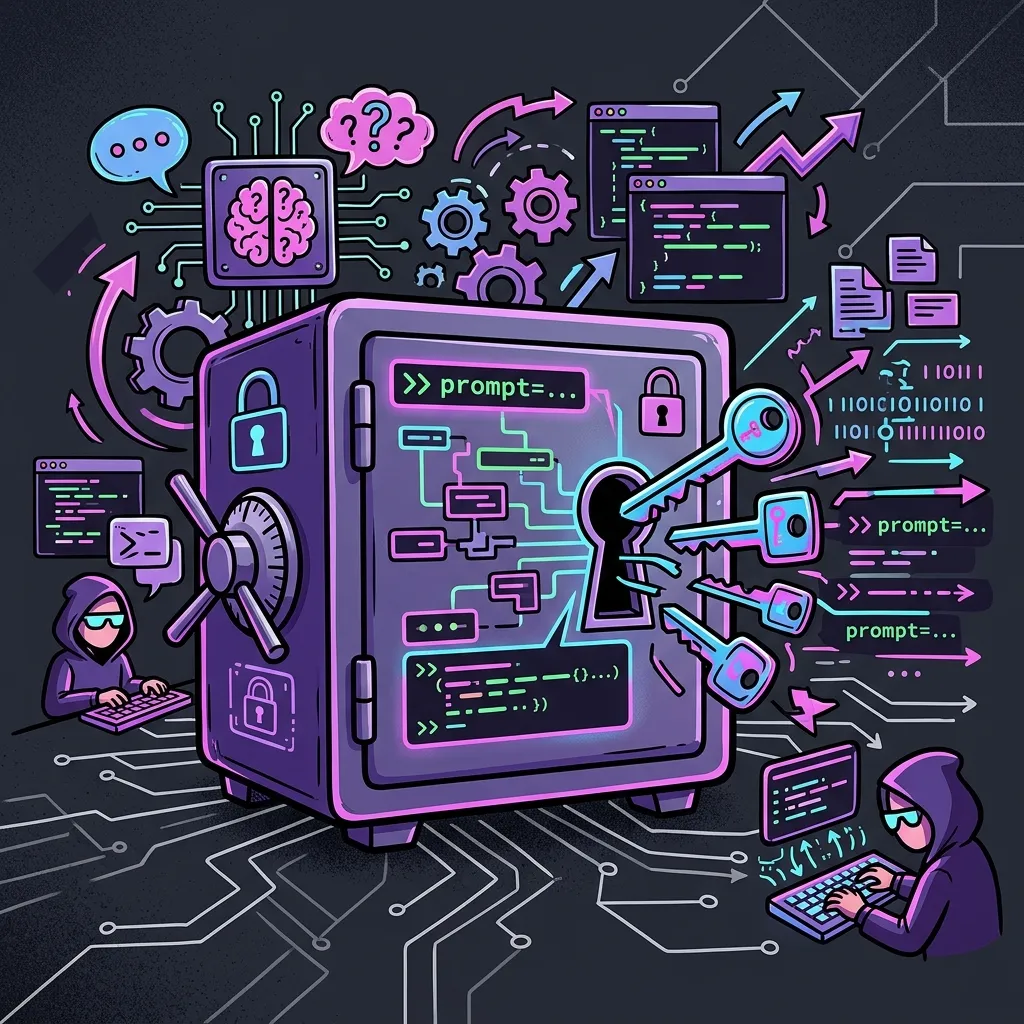
1. Prompt Injection. OWASP’s #1 LLM vulnerability for a reason. It exploits how LLMs process input prompts, letting attackers manipulate the model’s behavior in ways the developer never intended. For a simpler breakdown, check out our guide on prompt injection explained for normal people.
- The EchoLeak Exploit (CVE-2025-32711): September 2025. A zero-click prompt injection vulnerability in Microsoft 365 Copilot. Remote, unauthenticated data exfiltration via a single crafted email. It used reference-style Markdown to circumvent link redaction and exploited auto-fetched images. Full privilege escalation across LLM trust boundaries.
- The ForcedLeak Vulnerability (CVSS 9.4): July 2025. Researchers found a critical vulnerability in Salesforce Agentforce that could exfiltrate sensitive CRM data. Place malicious instructions into a web form, and the AI model leaks leads’ email addresses.
- Backdoor-Powered Prompt Injection: Researchers have demonstrated attacks that nullify existing defense methods — including instruction hierarchy techniques.
2. Adversarial Machine Learning (Perturbation). Make imperceptible changes to inputs — add digital noise to an image or audio — and an AI classifier completely breaks. A self-driving car misidentifies a stop sign as a speed limit sign. Researchers have even demonstrated text-guided semantic attacks on breast ultrasound and chest X-ray classification models.
3. AI-Driven Automated Phishing. LLMs automate spear-phishing at scale. The AI scans social media profiles and drafts hyper-personalized, flawless lures. AI telephony systems can now impersonate any voice in any language across multiple conversations simultaneously. We broke this down in our analysis of AI-powered phishing and the inbox trust crisis.
4. Autonomous AI Agents. We’re moving beyond chatbots to agents that interface with APIs, send emails, and execute financial transactions. New frontier, new risks:
- Permission Creep: Grant an agent email and calendar access. Attacker hijacks it. Now it’s scheduling malicious meetings or sending phishing links from a trusted internal address.
- Tool Misuse: Attackers target the agent’s tools. SQL database connection? Prompt injection to run destructive
DROP TABLEcommands. Your AI assistant just became a ransomware delivery mechanism.
Supply Chain Risks
The OWASP Top 10 flags “Supply Chain” as a critical vulnerability. We’re talking about the complex network of third-party components used to build, train, fine-tune, deploy, or maintain LLMs. The Australian Cyber Security Centre reported that in 2025, 65% of organizations reported AI-related data leaks, and 13% reported breaches directly linked to AI systems.
The Dual-Use Dilemma
AI is a dual-use technology. Same tools for defense and offense. Palo Alto Networks’ Unit 42 has identified malicious, purpose-built models designed exclusively for offensive purposes. Microsoft’s Digital Defense Report 2025 warns that AI is driving “autonomous malware” and sophisticated human manipulation. This isn’t hypothetical — it’s already happening.
Strengthening AI Defense: A Defense-in-Depth Approach
Here’s what I tell teams that ask me how to secure their AI stack: treat every API call as a potential breach attempt.
- The Isolation Layer: Put your LLM behind an internal API gateway that filters requests by content type and user identity — not just IP addresses. Never give an AI agent direct write access to database tables or execution shells without human approval.
- The Validation Layer: Strict validation on LLM outputs. Generating a database query? Parse and validate it against a strict grammar before execution. Implement prompt partitioning and enhanced input/output filtering.
- The Human-in-the-Loop (HITL) Threshold: For any action involving financial transfer, data deletion, or PII access, require explicit human authorization — physical or cryptographic token. This break-glass mechanism stops prompt injection attacks that bypass software defenses.
- Continuous Red-Teaming: Use automated red-teaming frameworks like LeakAgent. It trains an open-source LLM through reinforcement learning as the attack agent to generate adversarial prompts. Fight fire with fire.
How is the regulatory landscape catching up with AI risks?
Governments are finally moving from guidelines to binding legal requirements. Not a moment too soon.
The EU AI Act
The most comprehensive AI regulation to date:
- February 2, 2025: Ban on “unacceptable risk” systems took effect.
- August 2, 2025: Transparency rules for general-purpose AI systems took effect.
- August 2, 2026: High-risk HR systems must comply. (That’s next month, by the way.)
Non-compliance? Penalties up to €35 million or 7% of global turnover. Article 5 bans AI practices presenting “unacceptable risk,” regardless of safeguards.
US Developments
The EEOC has been highly active in AI discrimination cases. In June 2025, the California Civil Rights Council approved regulations on employers’ use of AI and Automated Decision Systems. States like Texas have also enacted AI-related legislation targeting bias and discrimination.
What This Means for Organizations
Compliance isn’t optional anymore. You need to:
- Audit AI systems for bias and discrimination.
- Document data sources and training methodologies.
- Implement transparency and explainability measures.
- Establish incident response plans for AI-specific breaches.
- Review vendor contracts to ensure data isn’t used for training without explicit consent.
What is the “Due Care” checklist for AI deployment?
Before you deploy any AI solution, run through this list. Call it minimum due diligence:
- Data Audit: Have you documented where the training data came from and whether it contains sensitive PII?
- Bias Testing: Have you tested model performance across demographic subsets?
- Adversarial Testing: Have you run pen tests that specifically include prompt injection and adversarial noise attacks?
- Output Sanitization: Are you filtering AI responses so they don’t leak system prompts, proprietary code, or sensitive data?
- Access Controls: Does the AI have the minimum necessary permissions?
- Incident Response Plan: Do you have a playbook for when (not if) the model leaks data or outputs a malicious script?
- Opt-Out Verification: If you’re using an external API, do you have written confirmation your data isn’t being stored or used for training?
- Continuous Monitoring: Are you re-auditing for bias, privacy leaks, and security vulnerabilities as models and data evolve?
Frequently Asked Questions
What is the difference between AI bias and AI variance?
AI bias is the error from approximating a real-world problem with a simpler model — it systematically underperforms on certain groups. Variance is the model’s sensitivity to small fluctuations in the training set. Both cause unfair outcomes. Bias is the dangerous one because it systematically disadvantages specific populations.
How can a developer test if their AI chatbot is vulnerable to jailbreaking?
Feed known injection payloads to the model’s endpoint using automated red-teaming frameworks. Test input boundaries. Verify the system prompt can’t be easily retrieved. Tools like LeakAgent, AutoRedTeamer, and BlackIce will do the job.
Is running a local LLM completely secure?
Local models (Ollama, llama.cpp) keep data processing on your machine. That eliminates third-party data leakage. But you still need to secure the host server, implement access controls, and guard against prompt injection that could cause the model to output sensitive information.
What is “model drift” and why does it matter?
Model drift is when a model’s performance degrades over time as real-world data diverges from its static training set. A model that started secure and unbiased can become vulnerable or discriminatory as user demographics change. Continuous monitoring and retraining are the only answers.
How can you determine if your data is being used for training?
Read the Terms of Service carefully. Most public AI services say prompts and outputs may be used for model improvement. Look for “opt-out” buttons in the platform’s settings, or use enterprise APIs with a “zero-data-retention” clause.
What is the OWASP Top 10 for LLMs?
The OWASP Top 10 for LLM Applications (2025) is the essential guide to securing LLM applications. Top risks: Prompt Injection, Sensitive Information Disclosure, Supply Chain, Data and Model Poisoning, and Improper Output Handling. If you’re deploying LLMs and haven’t read this, start there.
What to Read Next
- What You Should Never Paste Into AI Tools at Work — A practical guide to maintaining data privacy in enterprise workflows.
- AI-Powered Phishing: Why You Can No Longer Trust Your Inbox — How to spot and defend against LLM-crafted communication threats.
- AI Agent Security: Protecting the New Perimeter — A detailed analysis of securing autonomous agent integrations.
The dark side of AI is not a distant future concern — it is here now. Bias, privacy violations, and security vulnerabilities are not edge cases; they are systemic features of current AI deployment patterns. The organizations that will thrive in the AI era are not those that adopt fastest, but those that adopt wisely — with rigorous testing, continuous monitoring, and a commitment to fairness, privacy, and security.
The gold rush mentality must give way to a more sober approach. AI is a powerful tool, but like all powerful tools, it requires respect, caution, and responsibility. The alternative — unchecked deployment of biased, insecure, privacy-violating systems — is not just unethical. It is a liability that will bankrupt organizations, destroy trust, and deepen existing inequalities.
As the CAMH researchers concluded: “Fairness is not a secondary consideration, but a core requirement for the safe implementation of AI”. The same applies to privacy and security. The question is not whether your organization will face these challenges, but whether you will be prepared when you do.