

Table of Contents
- Definition: What Exactly Is IndexNow?
- History: From Crawlers to Push Protocols
- Why IndexNow Was Created
- Problems It Solves
- Traditional Search Engine Discovery
- The XML Sitemap Workflow
- Search Engine Crawling Before IndexNow
- Limitations of Traditional Indexing
- Evolution Toward Real-Time Indexing
- Future of Search Indexing
Definition: What Exactly Is IndexNow?
IndexNow is an open-source protocol that lets website owners instantly notify participating search engines when content is added, updated, or deleted. Instead of waiting for search engine crawlers to discover changes—which traditionally takes days or weeks—IndexNow lets publishers actively push notifications directly to search engines via a simple HTTP API call.
Think of it this way: traditionally, search engines are like mail carriers who visit every house on a street every day, whether or not anyone has mail. They knock on every door, check if anything changed, and move on. IndexNow flips this: when you have mail, you call the post office and say, “I have mail at this address.” The carrier comes directly to you—immediately.
The Core Concept: Pull vs. Push
| Aspect | Traditional Crawling (Pull) | IndexNow (Push) |
|---|---|---|
| Who initiates? | Search engine | Website owner |
| Speed | Days to weeks | Minutes |
| Efficiency | Crawls everything, wastes resources | Targets only changed URLs |
| Control | Search engine decides when | Publisher decides when |
| Cost | High server load from bots | Lower server load |
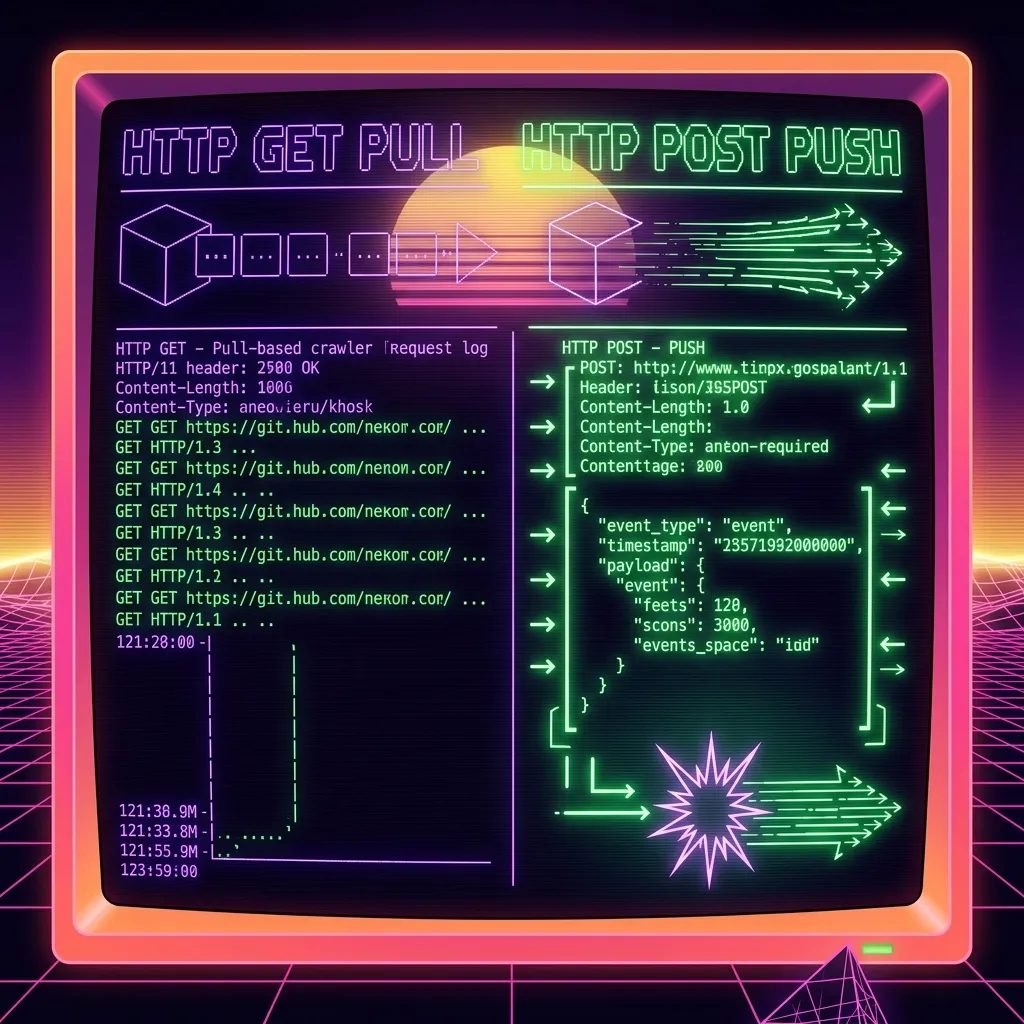 Fig 1.1: The terminal comparison log visually highlights the difference between slow pull-based crawls (left) that wait on crawler schedules, and fast push-based notifications (right) that trigger instant crawling payloads.
Official Definition (IndexNow.org): “IndexNow is an easy way for website owners to instantly inform search engines and web crawlers about latest content changes on their website. In its simplest form, IndexNow is a simple ping so that search engines know that a URL and its content has been added, updated, or deleted, allowing search engines to quickly reflect this change in their search results.”
How Simple Is It?
At its simplest, IndexNow requires three things:
- A key — A random string you generate (like a password)
- A text file — You place the key in a file at your website’s root
- An API call — When content changes, you send a simple HTTP request saying “this URL changed”
That’s it. No complex authentication, no monthly fees, no approval process.
History: From Crawlers to Push Protocols
The Early Web (1990s–2000s)
In the early days of the web, search engines discovered content by following links from page to page. This worked when the web was small, but as it grew, discovery became a bottleneck.
Key milestones in search discovery:
| Year | Development | Impact |
|---|---|---|
| 1998 | Google launches with PageRank | Link-based crawling becomes dominant |
| 2005 | XML Sitemaps introduced (Google, Yahoo, Microsoft) | Structured URL lists help crawlers, but still pull-based |
| 2008 | Google Webmaster Tools (now Search Console) launches | Manual URL submission becomes possible, but limited |
| 2015 | Google Indexing API announced | First push protocol, but restricted to job postings and livestreams |
| 2018 | Google Indexing API expands | Still limited to specific content types |
| 2021 | IndexNow launched by Bing and Yandex | First universal push protocol for all content types |
| 2022 | Seznam.cz joins | Czech market coverage |
| 2023 | Naver joins | South Korean market coverage; Yep joins |
| 2024 | 3.5 billion daily submissions | Massive adoption across the web |
| 2025 | WordPress plugins exceed 10M installs | Mainstream CMS adoption |
| 2026 | 5+ billion daily submissions; 80M+ websites | IndexNow becomes standard practice |
The Birth of IndexNow (October 2021)
IndexNow was announced on October 18, 2021, as a collaboration between Microsoft Bing and Yandex. The timing was strategic: both companies recognized the traditional crawling model was becoming unsustainable as the web grew.
Why Bing and Yandex led this:
- Both companies had the technical infrastructure to support real-time indexing
- Both faced competitive pressure from Google’s dominance
- Both recognized the environmental and efficiency benefits of push-based discovery
- Both wanted to level the playing field for smaller publishers
The protocol was released under the Attribution-ShareAlike Creative Commons License, making it free and open for anyone to implement.
Why IndexNow Was Created
The creators of IndexNow identified five problems with traditional search indexing:
Problem 1: The Discovery Delay
The Issue: When you publish a new blog post, update a product price, or delete an outdated page, search engines have no way of knowing until their crawler happens to visit that URL.
Real-World Impact: A news site publishes a breaking story at 9
AM. Without IndexNow, the story might not appear in Bing until 2 PM the next day. By then, the news is no longer “breaking”—it’s “old news.”The Numbers:
- Small blogs: Discovery can take 1–4 weeks
- Medium sites: Discovery typically takes 3–7 days
- Large sites: Discovery may take 1–3 days
- News sites with high authority: Discovery may take hours to 1 day
Problem 2: Crawl Budget Waste
The Issue: Search engines allocate a “crawl budget” to each site—the number of pages they’ll crawl per day. In the traditional model, most of this budget is wasted on unchanged pages.
Real-World Impact: An ecommerce site with 500,000 product pages sees Googlebot crawl 50,000 pages per day. If only 500 products changed prices that day, 49,500 crawl requests were wasted checking pages that hadn’t changed.
The Math:
Daily Crawl Budget:        50,000 pages
Actually Changed Today:       500 pages
Wasted Crawls:             49,500 pages (99% waste!)
This waste affects everyone:
- Publishers: Higher server load, bandwidth costs, hosting expenses
- Search engines: Higher operational costs, slower indexing
- Users: Stale search results, poor experience
- Environment: Unnecessary energy consumption
Problem 3: Content Staleness
The Issue: Users searching for information often encounter stale results.
Real-World Examples:
- A user searches “iPhone 16 Pro Max price” and clicks a result showing $1,199. The actual price was updated to $1,099 three days ago, but the search result still displays the old price.
- A customer searches for a restaurant’s hours and arrives to find it closed—the holiday hours changed last week, but search results show the old schedule.
- A student searches for “2026 tax filing deadline” and finds an article from 2024 with outdated information.
Problem 4: The Small Site Disadvantage
The Issue: Search engines crawl high-authority sites frequently and low-authority sites rarely. This creates a “rich get richer” dynamic where established sites get indexed faster while smaller sites struggle for visibility.
Real-World Impact: A new blogger publishes great content but waits weeks for discovery. Meanwhile, established sites get crawled daily. The new blogger loses traffic and the chance to build authority.
Problem 5: Fragmented Submission Systems
The Issue: Before IndexNow, each search engine had its own submission method:
| Search Engine | Submission Method | Daily Limit | Speed |
|---|---|---|---|
| Search Console URL Inspection | ~200 URLs | Hours | |
| Indexing API | 200 URLs | Minutes (limited content types) | |
| Bing | Webmaster Tools | 10,000 URLs | Hours |
| Yandex | Webmaster Tools | Varies | Hours |
| Naver | Search Advisor | Varies | Days |
The Problem: Site owners had to submit to each platform separately, track different limits, and manage multiple interfaces. There was no unified way to notify all search engines at once.
Problems It Solves
IndexNow addresses each of these problems:
| Problem | IndexNow Solution | Result |
|---|---|---|
| Discovery delay | Instant push notification | Content discovered in minutes |
| Crawl budget waste | Targeted crawling of changed URLs only | 20–40% reduction in bot traffic |
| Content staleness | Immediate reindexing of updates | Fresh, accurate search results |
| Small site disadvantage | Equal notification capability for all sites | Level playing field |
| Fragmented submission | One submission reaches all engines | Unified workflow |
Traditional Search Engine Discovery
To appreciate IndexNow, you need to understand what came before. Traditional search engine discovery works through several mechanisms:
Mechanism 1: Link Following (The Web Graph)
Search engine crawlers start with a seed list of known URLs and follow hyperlinks to discover new pages. This is how the web works.
How it works:
- Googlebot visits
example.com - It finds links to
example.com/page1,example.com/page2, etc. - It adds these to its crawl queue
- Later, it visits those pages and finds more links
- The process repeats indefinitely
Limitations:
- Orphan pages: Pages with no inbound links may never be discovered
- Deep pages: Pages many clicks from the homepage take longer to find
- New sites: Sites with few external links take weeks or months to be discovered
- Link decay: As pages are removed, link paths break, isolating content
Mechanism 2: XML Sitemap Discovery
An XML Sitemap is a file (typically sitemap.xml) that lists important URLs on a site, along with metadata.
A typical sitemap looks like this:
<?xml version="1.0" encoding="UTF-8"?>
<urlset xmlns="http://www.sitemaps.org/schemas/sitemap/0.9">
  <url>
    <loc>https://example.com/page1</loc>
    <lastmod>2026-06-20</lastmod>
    <changefreq>weekly</changefreq>
    <priority>0.8</priority>
  </url>
</urlset>
How it works:
- Website owner creates and maintains a sitemap
- Sitemap is submitted via Search Console or discovered via
robots.txt - Search engines periodically fetch the sitemap (daily to weekly)
- Crawlers visit listed URLs according to their scheduling algorithms
Limitations:
- Sitemaps are fetched on the search engine’s schedule
lastmoddates are often ignored or distrusted by crawlers- No guarantee that listed URLs will be crawled
- Large sitemaps must be split into multiple files
- Requires manual maintenance
Mechanism 3: RSS/Atom Feed Submissions
Blogs and news sites publish RSS feeds that syndicate new content. Search engines can subscribe to these feeds.
Limitations:
- Limited to blog posts and news articles
- Not suitable for product pages, service pages, or static content
- No support for updated or deleted content
- Feed discovery is declining in importance
Mechanism 4: Manual URL Submission
Search engines provide webmaster tools for manual URL submission.
Limitations:
- Extremely time-consuming for large sites
- Strict daily limits
- Requires separate submissions for each search engine
- Not scalable
The XML Sitemap Workflow
Let’s examine the traditional XML sitemap workflow in detail:
TIMELINE: Traditional XML Sitemap Discovery

Day 0, 10:00 AM  →  Content published on website
Day 0, 10:05 AM  →  CMS updates sitemap.xml automatically
Day 0, 11:00 AM  →  Sitemap generation completes
Day 1, 2:00 AM   →  Search engine fetches sitemap (scheduled check)
Day 1, 6:00 AM   →  New URL identified in sitemap
Day 1, 6:00 AM   →  URL added to crawl queue
Day 2, 3:00 PM   →  Crawler visits the URL
Day 2, 5:00 PM   →  Content processed and indexed
Day 3, 8:00 AM   →  Page appears in search results

Total time: 2–3 days (best case)
Worst case: 1–4 weeks
The bottleneck: The search engine decides when to check the sitemap. Even if you update it immediately, the crawler might not fetch it for hours or days.
Search Engine Crawling Before IndexNow
Before IndexNow, search engine crawling followed a predictable but inefficient cycle:
The Crawl Cycle
- Seed List Maintenance: Search engines maintain a massive database of known URLs (the “crawl frontier”)
- Scheduling Algorithm: An algorithm determines which URLs to crawl next based on:
- PageRank and link authority
- Historical update frequency
- Sitemap signals (often ignored)
- Server response times
- Crawl budget allocation
- Fetching: The crawler requests the HTML document
- Parsing: Content, links, and metadata are extracted
- Comparison: New content is compared against the stored version
- Indexing Decision: If changed, the page is queued for re-indexing
The Waste Problem
For most sites, the vast majority of pages don’t change between crawls. Yet crawlers must visit them anyway just to confirm nothing changed.
Example: A 100,000-page website
| Metric | Without IndexNow | With IndexNow |
|---|---|---|
| Daily crawls | 10,000 pages | 10,000 pages |
| Pages that actually changed | 200 pages | 200 pages |
| Wasted crawls | 9,800 (98%) | ~0 (0%)* |
| Crawl efficiency | 2% | ~100% |
*Search engines may still do some exploratory crawling, but it’s significantly reduced.
Limitations of Traditional Indexing
Traditional indexing has structural limitations that IndexNow was designed to solve:
| Limitation | Description | Business Impact |
|---|---|---|
| Latency | Days or weeks between change and indexing | Missed traffic, stale information, lost revenue |
| Inefficiency | Crawlers visit unchanged pages repeatedly | Higher hosting costs, slower server response |
| Scalability | Manual submission doesn’t scale | Enterprise sites struggle with large-scale indexing |
| Fragmentation | Different processes for each engine | Operational complexity, missed engines |
| No delete signaling | Hard to tell search engines content is gone | Users click dead links, poor UX, wasted crawl budget |
| Update ambiguity | Sitemaps show lastmod but crawlers ignore it | Unreliable update signaling |
| Orphan page blindness | Pages without links may never be discovered | Important content remains invisible |
| Authority bias | Low-authority sites get crawled less | New sites face discovery barriers |
Evolution Toward Real-Time Indexing
IndexNow is the latest step in a long evolution:
Timeline of Indexing Evolution
| Era | Technology | Discovery Model | Typical Speed |
|---|---|---|---|
| 1990s | Manual submission forms | Manual | Weeks |
| Early 2000s | Link-based crawling | Pull (passive) | Days to weeks |
| 2005 | XML Sitemaps | Pull (semi-active) | Days |
| 2010s | RSS/Atom + Ping services | Push (limited) | Hours to days |
| 2015 | Google Indexing API | Push (limited, Google only) | Minutes to hours |
| 2021 | IndexNow | Push (unified, multi-engine) | Minutes |
| 2026+ | AI-powered discovery | Hybrid (push + prediction) | Near real-time |
The Push Indexing Revolution
IndexNow is part of a broader trend toward push-based architectures:
- WebSub (PubSubHubbub): Push notifications for RSS feeds
- Google Indexing API: Push for job postings and live events (Google only)
- IndexNow: Unified push for general web content (multi-engine)
- AI Discovery Protocols: Emerging standards for AI search engines
Future of Search Indexing
Looking beyond 2026, several trends will shape search indexing:
Trend 1: AI-Powered Predictive Crawling
Search engines are using machine learning to predict which pages are likely to have changed. IndexNow data may feed into these models, creating a hybrid system where AI predicts changes and IndexNow confirms them.
Trend 2: Real-Time Indexing as Default
Within 3–5 years, real-time indexing may become the expected standard. IndexNow is laying the groundwork.
Trend 3: Unified Discovery Protocols
We may see convergence between IndexNow, Google’s Indexing API, and emerging AI discovery protocols into one standard.
Trend 4: Environmental Optimization
The efficiency gains of IndexNow (reducing unnecessary crawls by up to 50%) will become a selling point as sustainability becomes a priority.
Trend 5: AI Search Integration
Bing’s index powers ChatGPT Search, Microsoft Copilot, and DuckDuckGo. IndexNow submissions benefit visibility across the AI search ecosystem—not just Bing.com.
Key Takeaways
✅ IndexNow is an open-source push protocol that notifies search engines of content changes instantly
✅ It was launched in October 2021 by Microsoft Bing and Yandex
✅ It solves five critical problems: discovery delay, crawl waste, content staleness, small-site disadvantage, and fragmented submissions
✅ It represents a paradigm shift from pull-based (crawler-driven) to push-based (publisher-driven) indexing
✅ As of 2026, 80+ million websites use it, with 5+ billion daily URL submissions
✅ Google does not support IndexNow, but Bing’s index feeds AI search engines (ChatGPT, Copilot, Perplexity)
✅ The protocol is free, simple, and open-source under Creative Commons
Quick Reference Card
| Question | Answer |
|---|---|
| What is IndexNow? | A push protocol for instant search engine notifications |
| Who created it? | Microsoft Bing and Yandex (October 2021) |
| Is it free? | Yes, completely free and open-source |
| Which engines support it? | Bing, Yandex, Naver, Seznam.cz, Yep |
| Does Google support it? | No (as of 2026) |
| How fast is it? | Minutes (vs. days/weeks for traditional crawling) |
| Do I need to be technical? | No—plugins exist for WordPress, Wix, and other CMSs |
| Will it improve my rankings? | No—it improves indexing speed, not ranking position |
Next: Part 2: How IndexNow Works — The Complete Technical Workflow