
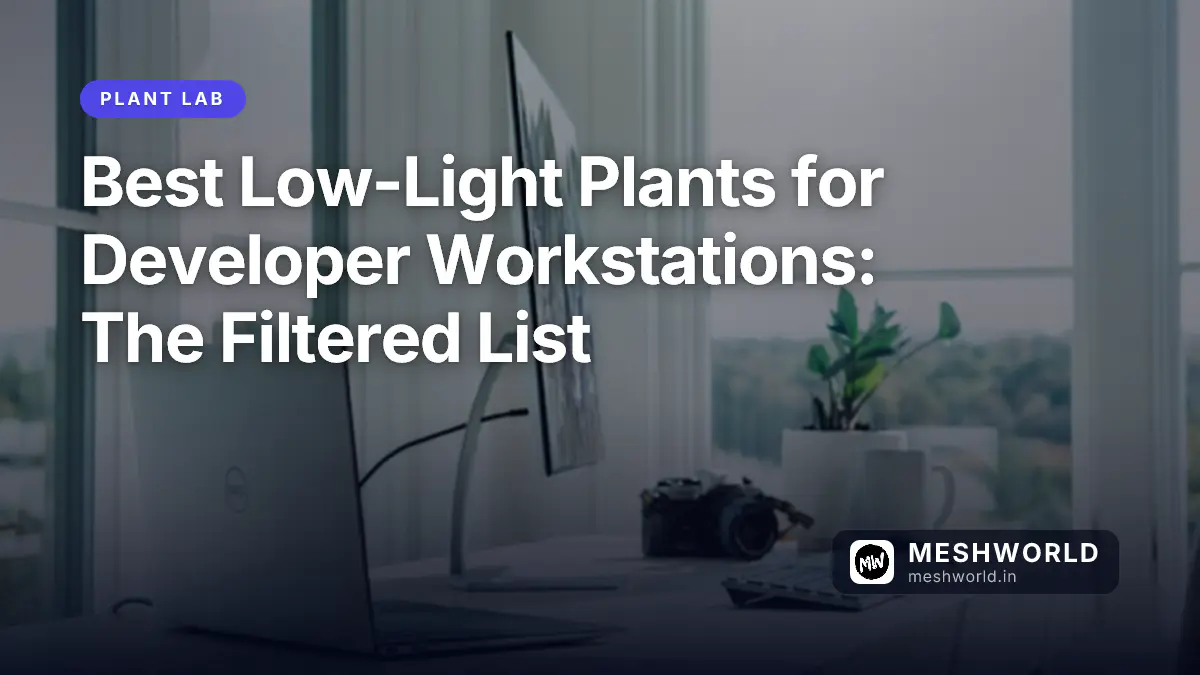
Developers spend more time optimizing their desk than most people spend on their living room. Monitor height, keeb angle, cable management, ambient light temperature — every detail gets iterated on.
Plants are the one variable most setups are missing. Not because greenery is trendy, but because a single well-placed plant reduces perceived screen fatigue, adds depth to a shallow desk, and filters the exact VOCs your laser printer and heated components are putting out.
The catch: most plant advice is useless for a dev desk. “Put it near a sunny window” doesn’t work when your monitors block the window. “Mist it daily” doesn’t work when there’s a ₹30k mechanical keyboard two centimeters away. “Give it room to grow” doesn’t work on a 60-inch desk already split between two monitors, a Stream Deck, and a DAC.
This is the filtered list: plants that fit an actual developer workstation.
The Dev Desk Constraints (Why Most Plant Advice Fails)
Before the list: a quick constraint map. Your workstation is not a garden. It has rules.
| Constraint | Impact on plant choice |
|---|---|
| Limited footprint | No plants wider than ~15cm base; tall and narrow wins |
| Artificial light only | No sun-lovers (succulents, cacti, most herbs) |
| Keyboard / peripherals nearby | No misting, no drip trays, no soil splash |
| Heat zones (GPU exhaust, monitor back) | Avoid placing plants directly in exhaust path |
| Cable runs on desk surface | No trailing vines at desk level (shelf placement instead) |
| No time for maintenance | Max watering frequency: once every 2 weeks |
Which Plants Actually Work on a Dev Desk?
1. Snake Plant (Sansevieria trifasciata) — The Default Pick
The snake plant is the mechanical keyboard of the plant world: extremely low-maintenance, looks good in a minimal setup, and doesn’t require any configuration after initial placement.
- Footprint: Narrow; the cylindrical Sansevieria cylindrica variety fits in a 10cm pot
- Light: Tolerates dim corners and artificial-only light indefinitely
- Water: Every 3 to 6 weeks. Forget about it.
- Cable risk: Zero. Upright growth, no trailing, no misting needed.
- Placement: Desk corner, beside monitor, or on a riser shelf
Why devs like it: The architectural shape looks intentional, not decorative. It reads “deliberate workspace design” rather than “I put a plant here.”
2. ZZ Plant (Zamioculcas zamiifolia) — The Offline-Capable Option
ZZ Plants store water in underground rhizomes. They are, biologically, designed for neglect. Watering schedule for a ZZ on your desk: once a month, maybe less in winter.
- Footprint: Medium; use a 12 to 15cm pot for a compact specimen
- Light: One of the best options for nearly zero natural light; fluorescent and LED desk lamps are sufficient
- Water: Every 3 to 4 weeks at most
- Cable risk: Zero
- Placement: Desk corner or shelf above monitors
Why devs like it: The glossy dark green leaves look perpetually clean and polished. Doesn’t collect dust visibly. Pairs well with dark mode setups.
3. Tillandsia / Air Plant — The Only Cable-Safe Option
Air plants (Tillandsia spp.) have no roots and no soil. They absorb moisture and nutrients through their leaves. This makes them the only plant on this list with zero risk to electronics.
- Footprint: Tiny; fits on a display stand, magnetic holder, or geometric shelf mount
- Light: Bright indirect light preferred; LED grow lamp works well
- Water: Dunk in water for 20 to 30 min once a week, shake dry, place back
- Cable risk: None — no soil, no drainage, no drip
- Placement: On a stand between monitors, mounted to a pegboard, inside a geometric terrarium
Why devs like it: The “no soil” angle is inherently interesting. Visitors ask about it. Also: putting a Tillandsia in a 3D-printed holder is a surprisingly satisfying side project.
4. Pothos — Shelf-Only (Not Desk Surface)
Pothos is one of the best air-purifying plants available, but it has a trailing growth habit that makes it desk-surface dangerous near cables. The correct placement: a shelf above the desk where the vines can trail downward without touching anything electronic.
- Footprint: Small pot, but needs vertical clearance for trailing
- Light: Low to bright indirect; works under a shelf lamp
- Water: Every 1 to 2 weeks
- Cable risk: Low if placed on a shelf above the desk surface; high if placed at desk level
- Placement: High shelf, cable tray ledge, floating wall shelf behind the setup
Why devs like it: Fast growth = visible progress. Propagation is free. One cutting in a small glass beaker on the desk (just water, no soil) is a valid minimal-footprint option.
5. Haworthia — The Only Succulent That Works Indoors
Most succulents need 6+ hours of direct sun. Haworthia is the exception — it evolved under shrubs and in rock crevices, not open sun. It handles indirect and artificial light far better than any other succulent, making it the one option for developers who want a sculptural desert aesthetic.
- Footprint: Tiny; fits comfortably in an 8cm pot
- Light: Bright indirect; works under a good LED desk lamp
- Water: Every 3 to 4 weeks; let soil dry completely
- Cable risk: Zero — no misting, minimal watering
- Placement: Beside a monitor, on a keyboard tray, anywhere with a lamp nearby
Why devs like it: Looks architectural and unusual. Low enough to not obstruct monitor sightlines. If you’ve killed succulents before — this one is genuinely harder to kill indoors.
Where to Place Them: Desk Positioning Guide
┌──────────────────────────────────────────────────────┐
│  [SHELF ABOVE]                                       │
│    Pothos (trailing down) │ ZZ Plant │ Air Plant     │
│──────────────────────────────────────────────────────│
│  [MONITOR LEVEL]          │                          │
│    Snake Plant (left)     │  Haworthia (right)       │
│    or ZZ Plant            │  or Tillandsia on stand  │
│──────────────────────────────────────────────────────│
│  [DESK SURFACE]                                      │
│    Pothos cutting in beaker (cable-safe, water only) │
│    Small Tillandsia on magnetic holder               │
└──────────────────────────────────────────────────────┘
Rules:
- Never place a plant directly behind GPU or monitor exhaust vents
- Keep soil-based plants at least 30cm from open keyboard/peripherals
- Trailing vines belong on shelves, not desk surface level
Quick Comparison
| Plant | Footprint | Light | Water | Cable-Safe? | Vibe |
|---|---|---|---|---|---|
| Snake Plant | Narrow | Low to Bright | 3 to 6 weeks | ✅ | Minimal / architectural |
| ZZ Plant | Medium | Very Low | 3 to 4 weeks | ✅ | Dark / polished |
| Tillandsia | Tiny | Bright indirect | Weekly dunk | ✅✅ | Experimental / modular |
| Pothos (shelf) | Small pot | Low to Bright | 1 to 2 weeks | ✅ (shelf only) | Lush / trailing |
| Haworthia | Tiny | Bright indirect | 3 to 4 weeks | ✅ | Desert / sculptural |
What to Read Next
- 10 Air-Purifying Plants for Developer Workstations: which plants actually filter the VOCs your dev gear produces
- Plants vs. Electronics: Managing Humidity Near a PC Setup: the humidity numbers your GPU cares about and which plants stay below them
- Biophilic Design for Tech Workspaces: the full workspace design strategy beyond individual plants
Frequently Asked Questions
Can I put a succulent on my desk under LED lights?
Most succulents need 6+ hours of direct sun — typical desk LEDs won’t cut it. The only reliable exception is Haworthia. If you want a sculptural low-water option, go Haworthia or Tillandsia instead of a standard succulent.
What’s the smallest plant I can put directly on a keyboard?
A Tillandsia on a small display stand. No soil, no water risk, fits in 5cm of space. If you 3D print a stand, it becomes a conversation piece.
Will Pothos roots damage my desk or USB hub?
No. Pothos roots in water (propagation cuttings) are inert and won’t damage surfaces. The risk is moisture — keep the water container sealed or use a narrow-neck glass so water can’t splash onto USB ports.
How do I water desk plants without spilling near a keyboard?
Use a squeeze bottle or a small watering can with a long narrow spout. Water directly into the pot, not onto the leaves. Keep a folded paper towel nearby. Do your watering before your desk session, not during.