


The 2026 FIFA World Cup isn’t just the first 48-team tournament hosted across three nations — it’s arguably the most technologically instrumented football event in history. Spread across 104 matches and 16 venues in Canada, Mexico, and the United States, FIFA has layered in semi-automated offside technology (SAOT), an expanded video assistant referee (VAR) mandate, connected ball telemetry, goal-line technology, and a standardized football data platform that, for once, every team gets to use equally.
That’s a lot of moving parts, and most of them are invisible to anyone watching from the stands or the sofa. So this piece walks through what’s actually running under the hood — how the systems talk to each other, and what it changes for officiating, broadcast, and the way teams prepare.
The 2026 Technology Stack at a Glance
| System | Role | Key Spec | Debut/Expansion |
|---|---|---|---|
| Semi-Automated Offside Technology (SAOT) | Automated offside line generation + kick-point detection | 16 roof-mounted cameras × 29 body points/player × 50Hz | Full deployment across all 16 venues (first at men’s WC scale) |
| Connected Ball (Adidas Trionda) | IMU sensor for ball-contact timestamp | Panel-mounted IMU, 500Hz sampling, Kinexon-developed | First World Cup with panel-mounted (not bladder-suspended) sensor |
| Expanded VAR | Decision review for 4+ categories | 42 cameras per match, centralized VOR in Dallas + on-site support | New review categories: 2nd-yellow reds, wrong corners, attacking fouls |
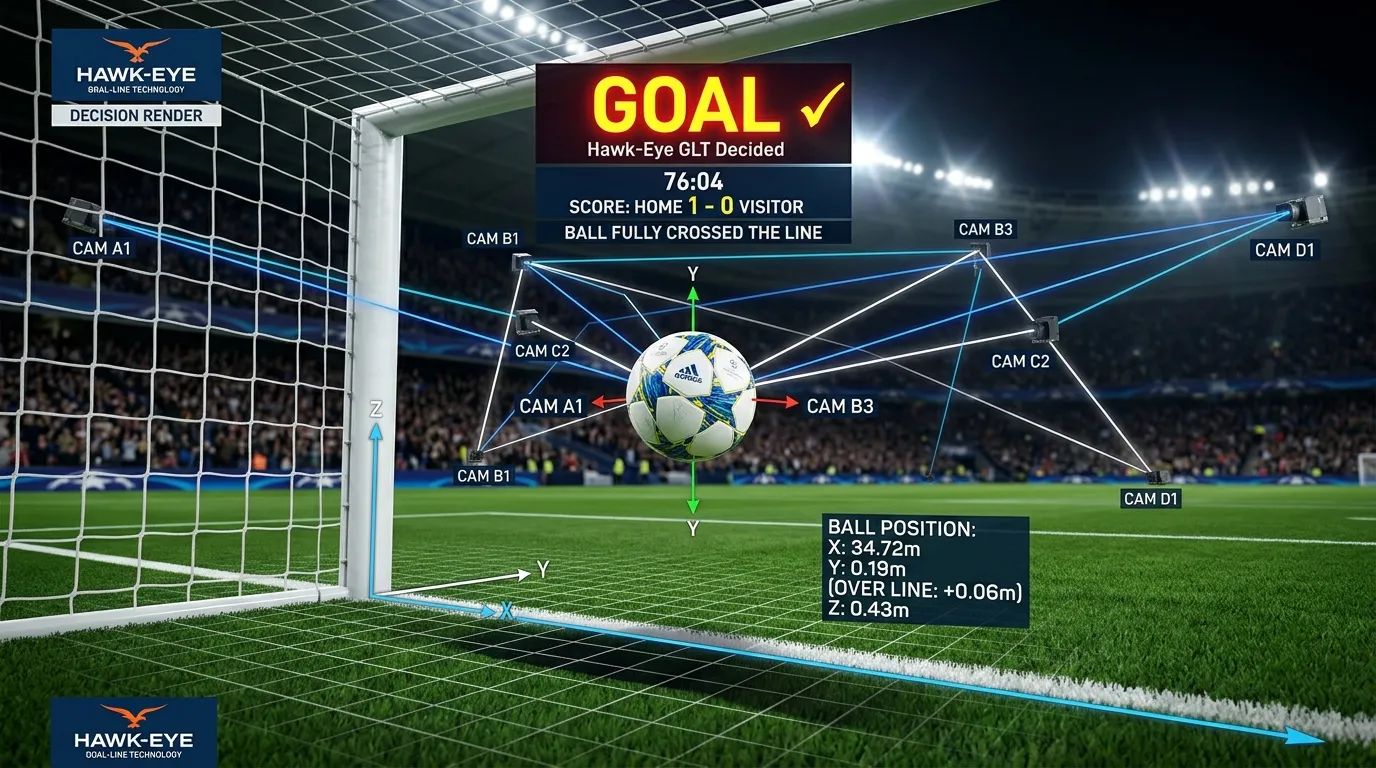
| Goal-Line Technology (GLT) | Goal/no-goal confirmation | Hawk-Eye (16 venues), under 1s latency | Standard since 2014; now shares camera infra with SAOT |
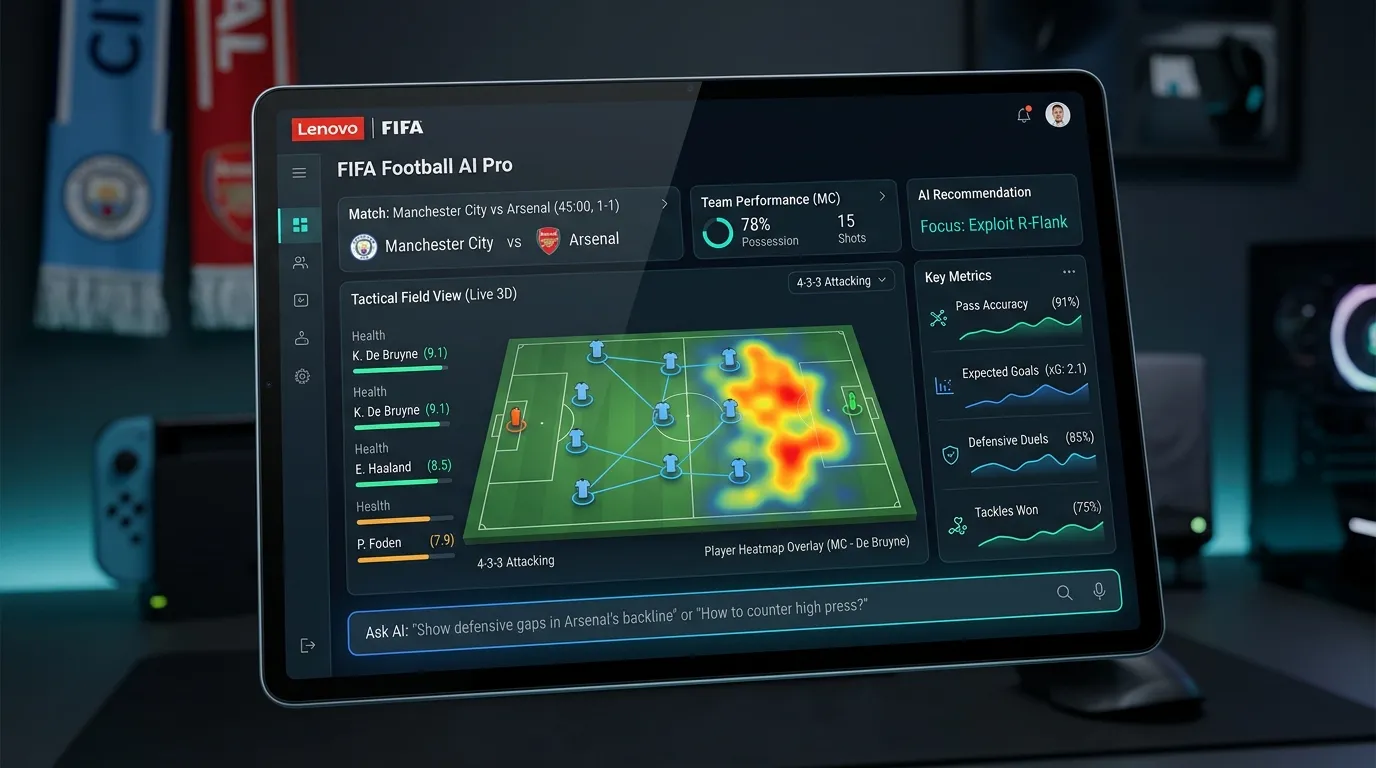
| Football AI Pro | Generative tactical analysis platform | Multi-agent orchestration, 300 million+ data points | Co-developed with Lenovo; ensures analytics parity |
| Referee View | First-person stabilized bodycam feed | Lenovo AI stabilization + real-time transmission | Full debut after successful Club World Cup trial |
Inside Semi-Automated Offside Technology
How It Works
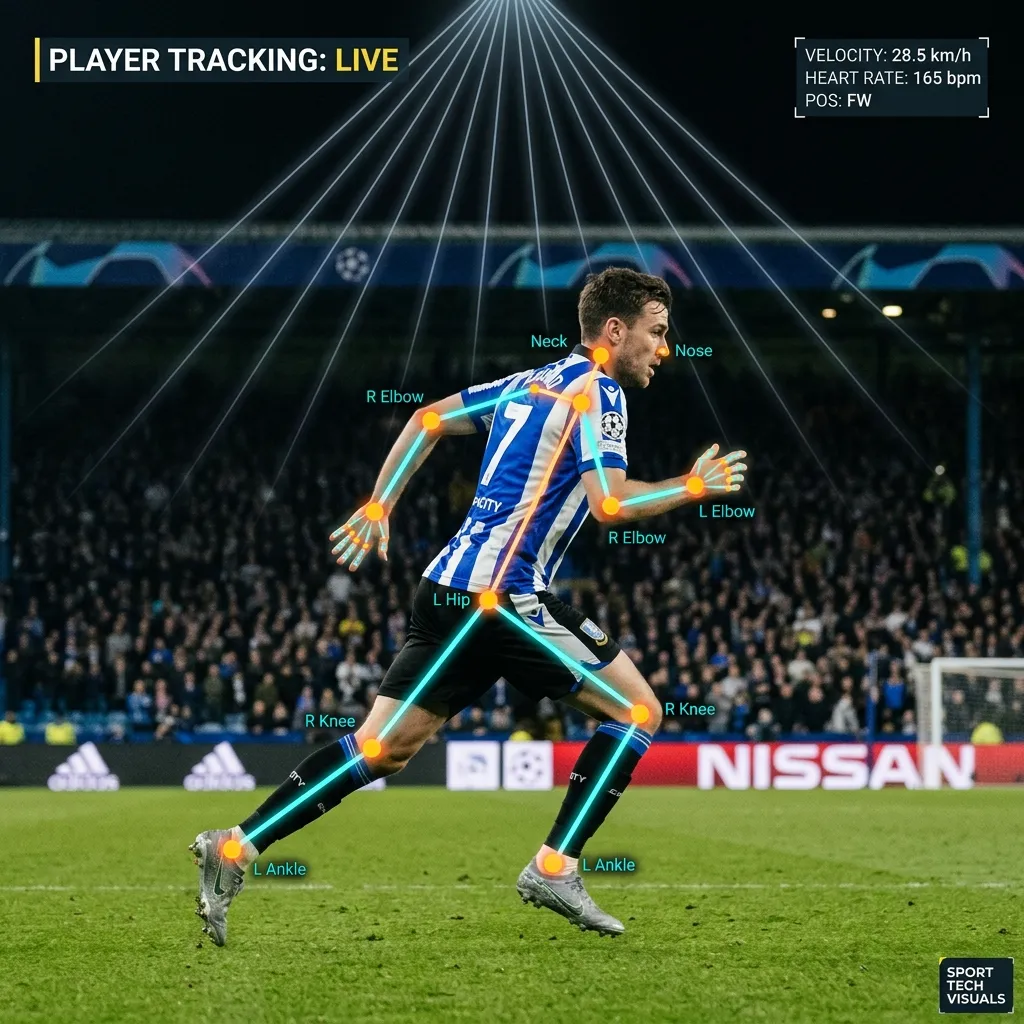
SAOT at the 2026 World Cup builds on the system FIFA debuted in Qatar in 2022 and then sharpened at the 2025 Club World Cup. Each stadium runs 16 dedicated optical tracking cameras mounted beneath the roof structure, and between them they track:
- 29 data points per player (including limbs, shoulders, knees, feet — every body part relevant to Law 11 offside decisions)
- 50 frames per second temporal resolution
- 150 million tracking data points generated per match
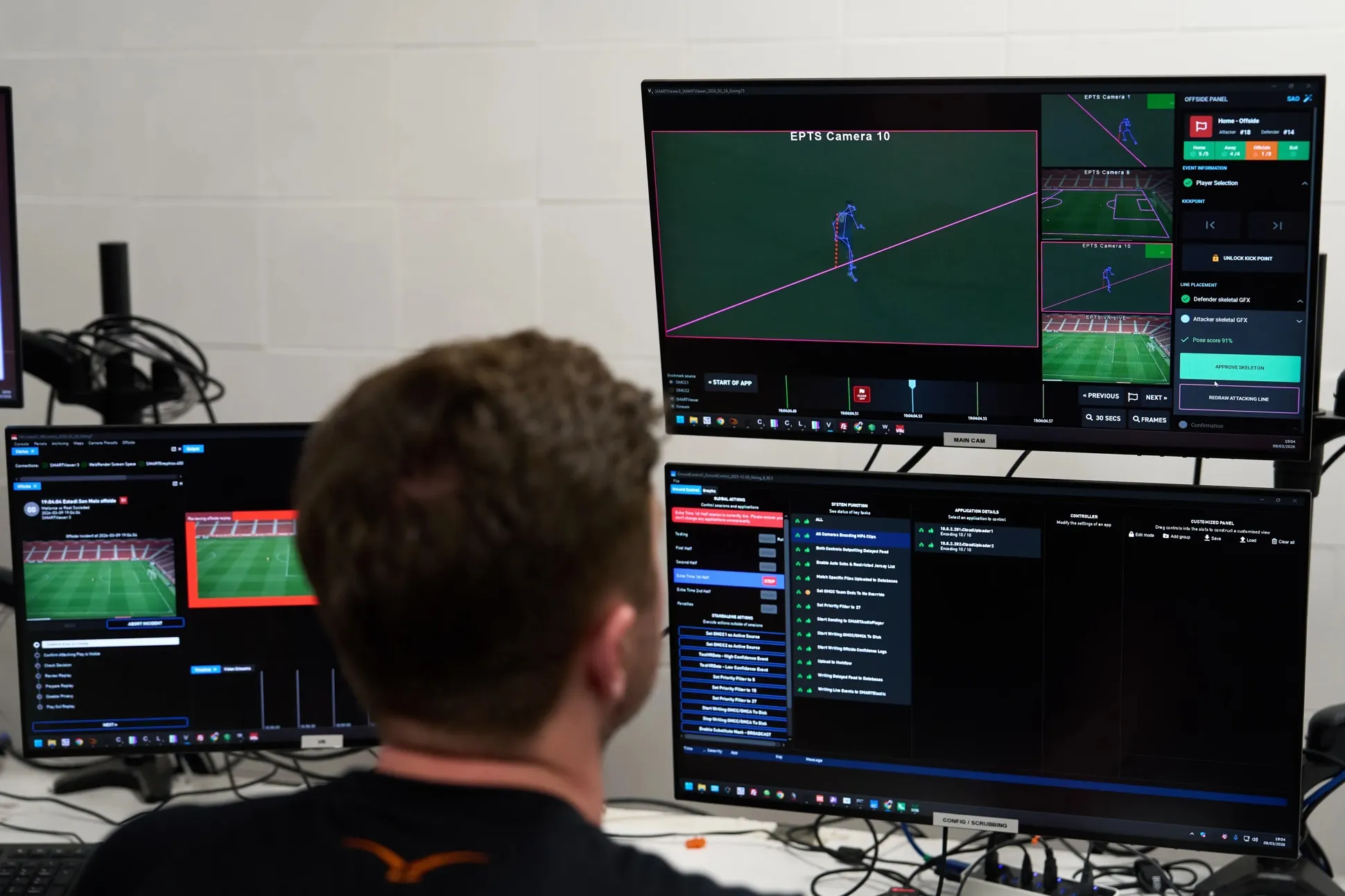
The system computes virtual offside lines automatically and identifies the exact frame when the ball is played by an attacking teammate. When a potential offside offence is detected, an alert is sent to the officiating team.
The Role of 3D GenAI Avatars
Before the tournament, all 1,248 players across the 48 squads underwent rapid digital body scans. The capture process requires less than one second of active scanning (around 30 seconds total including preparation). Using advanced GenAI technology, the system converts these scans into highly individualized 3D avatars with precise body dimensions.
Because no two avatars are identical, the system avoids generic skeletal tracking, allowing the SAOT software to accurately determine the exact body boundary of a player even in crowded penalty areas. Once confirmed, these 3D animations are rendered for in-stadium screens and global television broadcasts within seconds.
The “Semi” in Semi-Automated Still Matters
Despite all the automation, human officials remain in the loop — and that’s by design, not a limitation FIFA is quietly working around. The workflow runs like this:
- Automated detection → System flags potential offside and proposes a line + kick-point frame.
- On-Pitch Assistant Alert → For clear offside decisions exceeding a 10cm threshold (tightened from Qatar’s 50cm), the system sends a real-time audio alert directly to the assistant referee’s earpiece on the pitch. This enables immediate flag raises and minimizes the injury risk associated with delayed whistles.
- VAR review → For tight or subjective incidents, video assistant referees verify the proposed line, check for obstructions, and confirm the kick-point using ball-sensor data.
- Referee communication → VAR advises the on-field referee. If subjective interpretation is needed (e.g., active interference with play), the referee conducts an On-Field Review (OFR).
The Adidas Trionda Is a Sensor, Not Just a Ball
Physical Specifications
The official match ball for the 2026 World Cup is the Adidas Trionda (specifically the Trionda Pro), and its name is a bit of a pun: “tri” for the three host nations — Canada, Mexico, and the United States — and “onda,” Spanish for “wave.”
| Property | Value |
|---|---|
| Panels | 4 thermally bonded polyurethane panels (fewest in WC history) |
| Surface | Debossed macro/micro texture inspired by “la ola” (the wave) for flight stability |
| Colors | Tricolor scheme: Red (maple leaf), Green (golden eagle), Blue (five-point star) |
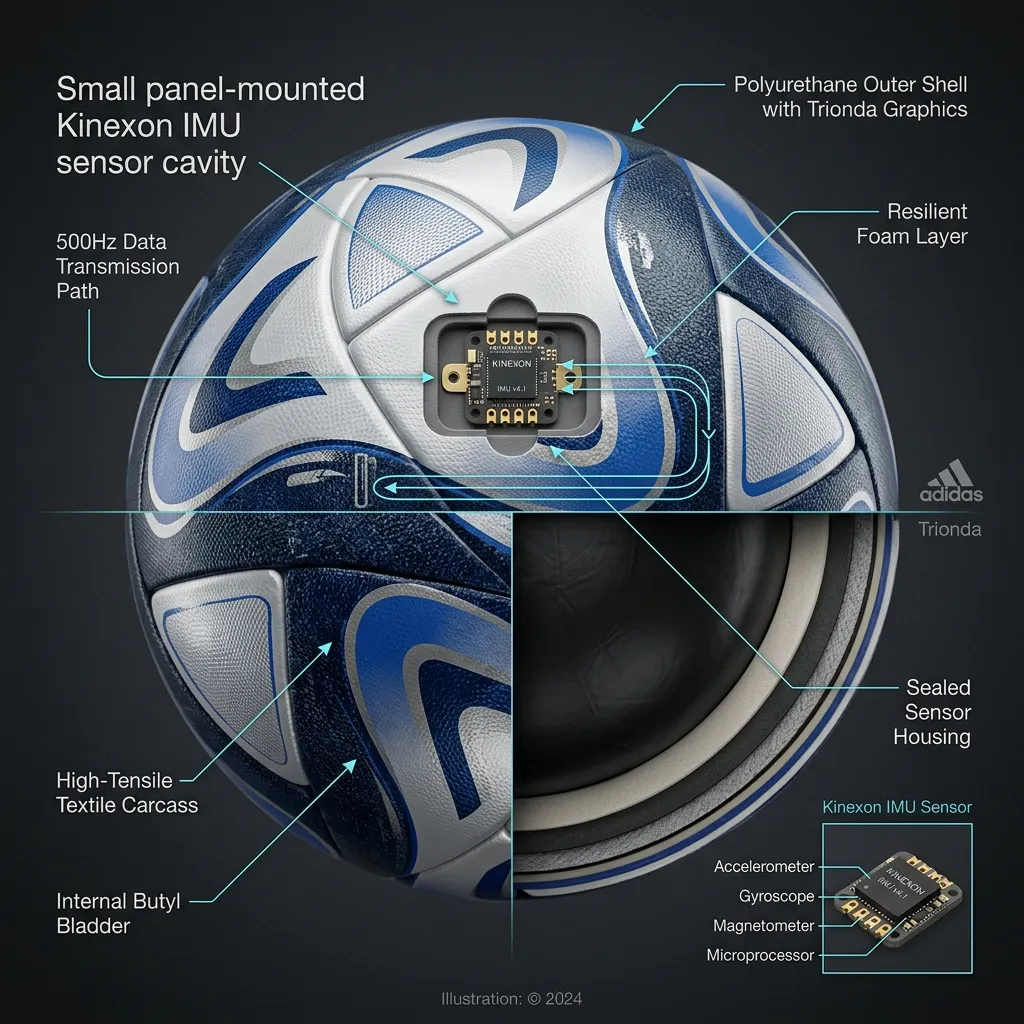
| IMU | Panel-mounted inertial measurement unit (Kinexon, Munich) |
| Sampling rate | 500 Hz (ball contact, rotation, acceleration, orientation) |
| Data latency | under 1 second to VAR workstation |
| Manufacturer | Forward Sports (Sialkot, Pakistan) |
Why Moving the IMU to the Panel Matters
The 2022 Al Rihla suspended its IMU inside the bladder on a stabilization frame — a clever solution, but a mechanically fussy one. The Trionda instead tucks the sensor into a dedicated cavity in one of its four outer panels, which brings a few real advantages:
- No suspension system → fewer mechanical failure points.
- Direct panel coupling → cleaner impact transient detection (the “kick spike” is sharper and easier to isolate).
- Manufacturing consistency → panel integration is more repeatable than bladder suspension.
- Thermal stability → panel-mounted sensor experiences less temperature drift.
The IMU transmits quaternion orientation, linear acceleration, and angular velocity at 500Hz via a proprietary low-latency protocol to sideline receivers, then to the VOR. This data is time-synchronized with the optical tracking system (NTP/PTP disciplined clocks at each venue).
Data Flow: Ball → VAR → Broadcast
[Trionda IMU @ 500Hz] → [Sideline Receiver] → [Venue Edge Server]
                                                      ↓
[16 Optical Cameras @ 50Hz] → [Tracking Engine] → [Fusion Engine]
                                                      ↓
                                    [VAR Workstation: Kick-point + Offside Line]
                                                      ↓
                              [3D Animation Engine] → [Stadium Screen + Broadcast]
The fusion engine correlates the IMU impact spike (ball contact) with the optical frame showing the passer’s foot-ball contact. This dual-source verification reduces kick-point ambiguity from ±1 frame (20ms) to ±2-3ms — critical for millimeter offside calls.
Sensor Data Transmission and Time Synchronization
To route telemetry without interfering with stadium Wi-Fi or broadcast equipment, the Trionda’s Kinexon sensor transmits over a proprietary Ultra-Wideband (UWB) frequency band (typically between 3.25 GHz and 4.75 GHz). A series of 12 receivers positioned at pitch level collect the signals and forward them to the local venue’s edge servers.
A primary challenge in connected officiating is avoiding “clock drift” between different physical components. If the ball sensor’s timestamp is even slightly out of sync with the video cameras, the resulting offside calculations are useless. To solve this, all stadiums use IEEE 1588 PTP (Precision Time Protocol), which coordinates every optical camera sensor, the stadium edge nodes, and the pitch-level wireless receivers to a master atomic clock. This keeps network synchronization jitter below 1 microsecond, ensuring the 500Hz ball contact data matches up frame-by-frame with the 50Hz player cameras.
VAR Gets a Bigger Remit in 2026
The tournament adds four new reviewable decision categories on top of the original four (goal/no-goal, penalty/no-penalty, direct red card, mistaken identity):
| New Category | Description | Technology Dependency |
|---|---|---|
| Red card from 2nd yellow | VAR can review whether the first yellow was correctly issued (clear and obvious error standard) | Match footage + VAR audio logs |
| Wrongly awarded corner kicks | Ball last touched by attacker vs. defender before crossing goal line | Goal-line cameras + optical tracking |
| Attacking fouls in penalty area | Handball, pushing, holding by attacker before goal/scoring chance | Multi-angle replay + SAOT player positions |
| Goalkeeper handling outside area | Factual position of ball/keeper at moment of contact | GLT cameras + tracking data |
VAR Infrastructure at Scale
- 30 dedicated Video Assistant Referees appointed (up from 24 in 2022)
- 52 referees, 88 assistant referees on-field
- 42 cameras per match (broadcast + dedicated VAR + offside + goal-line)
New On-Field Rules Enforced by Technology
| Rule | Enforcement Mechanism |
|---|---|
| 10-second substitution limit | Fourth official timer + stadium clock sync; VAR can flag violations |
| 5-second restart countdown | Visual countdown on referee’s watch + stadium boards; triggered by referee for time-wasting |
| Mandatory 3-minute hydration breaks | Automated scheduling in match management system; broadcasters get fixed ad windows |
| Mouth-covering red card | VAR reviews footage for concealed dissent; AI-assisted lip-reading prototype tested |
Why Dallas Is the Nerve Center for Every Match
Running 104 matches across 48 teams is one thing; keeping officiating decisions consistent across all of them is another problem entirely. FIFA’s answer is a hybrid setup centered in Dallas, Texas.
The Kay Bailey Hutchison Convention Center doubles as the International Broadcast Centre (IBC) and houses the centralized VAR room. Each match still keeps a Video Operation Room (VOR) on-site for redundancy and zero-latency communication, but every video stream also gets routed to the Dallas hub in parallel.
That centralization lets FIFA do a few things it couldn’t manage otherwise:
- Deploy Technical Innovation Teams: Oversee the performance of the optical tracking cameras and the connected ball sensor feeds across all live matches.
- Maintain Officiating Consistency: A dedicated group of elite VAR supervisors monitors every VOR decision to ensure the “clear and obvious error” standard is applied identically across Canada, Mexico, and the US.
- Manage Fiber Connectivity: All 16 venues are connected via dual 10Gbps dedicated fiber rings, enabling video and data feeds to reach Dallas with less than 50 milliseconds of network transport latency. That centralization lets FIFA do a few things it couldn’t manage otherwise. Technical Innovation Teams in Dallas oversee the optical tracking cameras and connected ball sensor feeds across every live match at once. A dedicated group of elite VAR supervisors monitors every VOR decision, making sure the “clear and obvious error” standard gets applied identically across Canada, Mexico, and the US. And all 16 venues connect to Dallas via dual 10Gbps dedicated fiber rings, keeping network transport latency under 50 milliseconds.
Referee View: Fixing the Motion Blur Problem
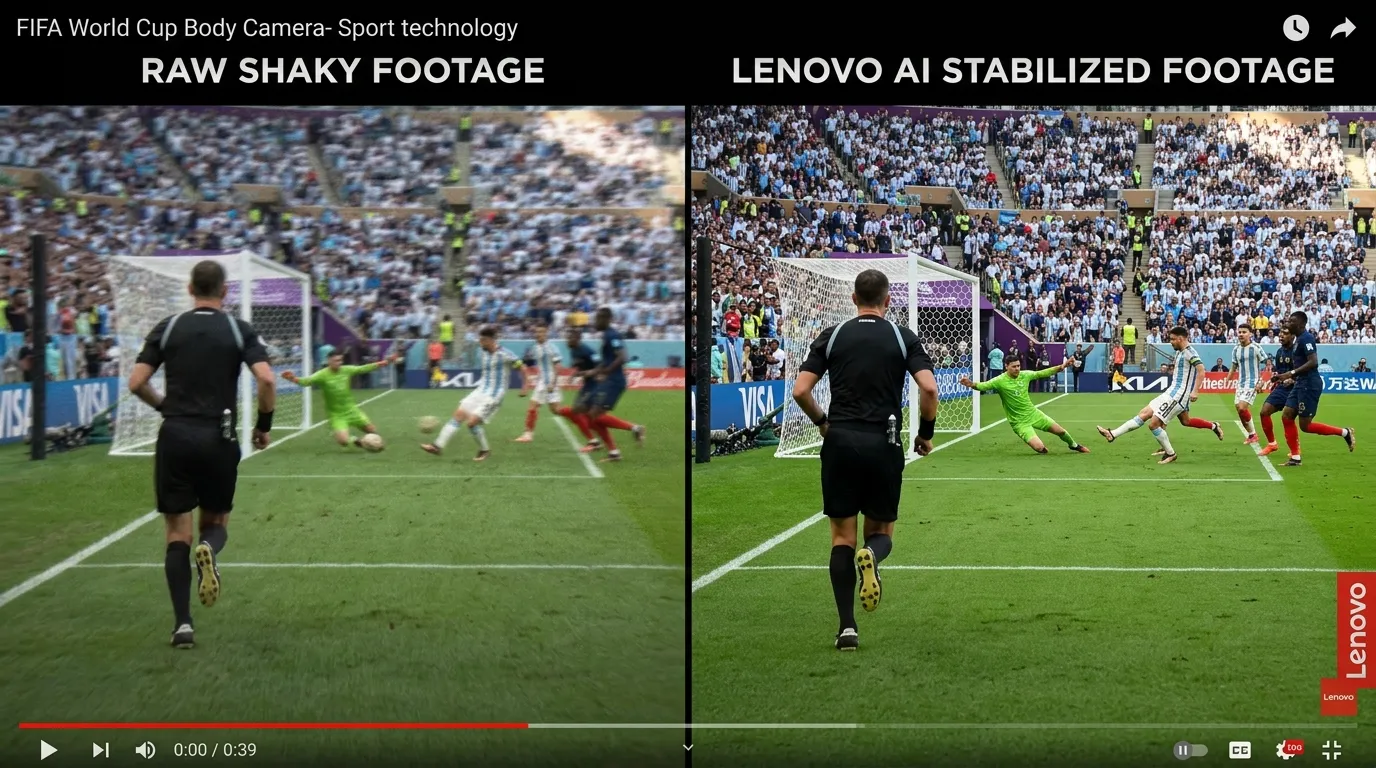
Referees at the 2026 World Cup wear body cameras, giving fans and broadcasters a first-person angle on pitch decisions that simply didn’t exist before. The catch is that a camera strapped to someone sprinting, pivoting, and jumping produces exactly the kind of footage you’d expect — shaky, blurred, often unusable.
Lenovo’s fix is a real-time AI-driven video stabilization layer running on the stadium’s local edge compute nodes. It:
- Automatically detects and isolates camera shake and high-frequency vibrations.
- Employs deep learning models to predict motion paths and reconstruct blurred frames.
- Delivers a stabilized, high-definition “Referee View” feed to global broadcast teams with under 100ms of processing latency.
Goal-Line Technology: The Old Reliable
GLT is the veteran of this whole stack — the oldest and, frankly, the most trusted electronic aid in the sport. At the 2026 World Cup:
- All 16 WC venues use Hawk-Eye (FIFA’s preferred provider for tournament consistency)
- 14 high-speed cameras per goal track the ball at 500Hz+
- Latency: under 1 second from ball crossing line → referee watch vibration + visual alert
- Integration: GLT cameras now share calibration data with SAOT tracking cameras, reducing setup time per venue
The system is passive — it only activates on goal-line incidents, and there’s no AI inference involved at all, just pure geometric triangulation. That reliability is exactly why it’s the one system a referee doesn’t second-guess on a pitchside monitor: the watch buzzing on their wrist is the decision.
Levelling the Analytics Playing Field
For the first time at a 48-team World Cup, every participating team gets standardized tracking data for every match through the FIFA Football Data platform — a deliberate move to close the gap between football’s wealthiest federations and its smaller ones.
Football AI Pro
At the center of the platform sits Football AI Pro, a generative AI tactical assistant FIFA built with Lenovo. Instead of handing coaches a static 50-page match report to wade through, it lets analysts just ask questions in plain language and get answers back.
Built on FIFA’s custom Football Language Model and powered by Lenovo’s AI Factory, the tool:
- Orchestrates multiple AI agents to process over 300 million data points per match.
- Tracks and correlates more than 2,000 distinct metrics per player.
- Generates written tactical reports, cuts video replays based on complex instructions, and renders 3D animated tactical simulations of team shapes.
- Note: To maintain sporting integrity, this tool is restricted to pre- and post-match use and cannot be accessed during active play.
What Fans and Broadcasters Get Out of All This
Automated Match Recap Generation
FIFA’s broadcast partners — Fox Sports, Telemundo, Bell Media, plus the TikTok and YouTube “preferred platform” deals — receive AI-curated key moments packages within minutes of key events:
- Goal sequences: Auto-clipped from multi-camera feeds using event detection (ball-in-net + crowd audio spike + referee whistle)
- VAR decisions: Synchronized multi-angle replays + 3D offside animation packaged as a single clip
- Player milestones: Debut, 100th cap, hat-trick triggers auto-assemble career tribute videos
Real-Time xG and Win Probability
Broadcast graphics now display live expected goals (xG) and win probability models updated after every shot, possession change, and substitution. These models consume:
- Tracking data (player/ball positions)
- Historical shot database (20,000+ World Cup shots since 1966)
- Contextual features: score, minute, red cards, venue altitude
3D Offside Animations for Spectators
The same 3D animations generated for VAR review are rendered for stadium screens and TV within 10-15 seconds of decision confirmation. The 2026 goal is to consistently deliver a render-to-air latency under 10 seconds.
Multilingual AI Commentary
FIFA+ streaming offers AI-generated commentary tracks in 12 languages beyond the primary broadcast languages, using:
- Neural TTS trained on FIFA’s historical commentary corpus.
- Real-time event detection feeding structured prompts to LLMs for contextual narration.
- Human post-editors for high-stakes matches (knockout stage).
Kitting Out 16 Stadiums the Same Way
Each of the 16 venues got the same standardized technology fit-out, managed centrally by FIFA’s innovation team so no stadium is running on a different setup:
| Component | Specification |
|---|---|
| Tracking cameras | 16 × roof-mounted (SAOT) + 14 × goal-line (Hawk-Eye) + 16 × broadcast VAR feeds |
| Edge compute | 3× NVIDIA DGX nodes per venue (tracking fusion, animation render, streaming encode) |
| Network | Dedicated 10Gbps fiber ring per venue; PTP (IEEE 1588) clock sync across all sensors |
| VAR workstation | 4× 4K monitors, dedicated audio comms to referee, touchscreen OFR interface |
| Stadium screens | 4K/60Hz capable; receive 3D animations via dedicated low-latency path |
| Backup | Battery-backed edge nodes (15 min); secondary fiber path to IBC Dallas |
Eight venues are indoor or retractable-roof (Atlanta, Dallas, Houston, Vancouver, plus Guadalajara, Mexico City, Monterrey, Toronto), and each of those needed custom camera mounting solutions to dodge roof-structure occlusion. FIFA also brought in the University of Tennessee–Michigan State turf research team for the hybrid grass installation (84% Kentucky bluegrass / 16% perennial ryegrass for cool climates, Bermuda for warm) — a detail that sounds unrelated to AI tracking until you realize turf consistency affects ball roll, which in turn affects tracking calibration.
The Numbers So Far
Sixty matches into the tournament, we’re no longer talking about theory — there’s enough data now to say how these systems are actually performing under real pressure, not just in testing. A few things stand out from FIFA’s own figures as of early July 2026:
- Reduced Review Latency: The average time taken to confirm an offside decision has dropped from 70 seconds in 2018 (using manual lines) to under 22 seconds in the ongoing 2026 tournament.
- Millimeter Accuracy: The combination of the Trionda’s 500Hz IMU and SAOT’s 29-point player mesh has successfully resolved 14 highly complex offside calls where the margins were under 3 centimeters.
- Fewer Stoppages: Thanks to the automated kick-point detection and edge-rendered 3D visuals, VAR reviews have caused 18% fewer interruptions to active play compared to the 2022 edition.
It’s Not All Smooth Running
None of this is as clean as the marketing suggests, and it’s worth being honest about where the systems still struggle — technically, legally, and politically.
Technical Limitations
| Issue | Status |
|---|---|
| Crowded penalty areas | SAOT accuracy drops when >8 players in 5m radius; VAR manual override required |
| Player obstruction | Camera occlusion in dense packs; system flags “low confidence” for human review |
| Kick-point ambiguity | Even with 500Hz IMU, foot-ball contact duration (~8-12ms) spans multiple IMU samples; fusion engine uses peak acceleration heuristic |
| Communication latency | Venue-to-Dallas central hub adds 30-50ms; acceptable for review, not for real-time automation |
Biometric Compliance and Privacy Concerns
Running AI surveillance at this scale across 16 stadiums in three countries was never going to pass without pushback, and groups like the ACLU and Privacy International have been vocal about it. Their concerns center on:
- Facial Recognition: Deployed at entry gates for identity verification and watchlist matching.
- Boston Dynamics Spot: Robotic patrol units deployed for perimeter security.
- Jurisdictional Conflicts: Operating across multiple data-protection frameworks, including Europe’s GDPR (affecting European travelers), the California Consumer Privacy Act (CCPA), the Illinois Biometric Information Privacy Act (BIPA), and the newly active EU AI Act.
- Data Retention: Questions remain regarding how long player tracking and spectator biometric profiles are archived by stadium security databases. Running AI surveillance at this scale across 16 stadiums in three countries was never going to pass without pushback, and groups like the ACLU and Privacy International have been vocal about it. Facial recognition is deployed at entry gates for identity verification and watchlist matching, and Boston Dynamics’ Spot robots patrol for perimeter security — both a step further than most fans expect from a football tournament. The bigger headache is jurisdictional: operating across GDPR (which covers European travelers), California’s CCPA, Illinois’ BIPA, and the newly active EU AI Act means the tournament is threading several incompatible data-protection frameworks at once. And nobody’s said clearly how long player tracking and spectator biometric profiles sit in stadium security databases before they’re deleted.
Operational Criticisms
- Cost disparity: Smaller federations argue the technology stack favors wealthy nations with analyst teams to exploit FIFA Football Data.
- Transparency: VAR audio still not broadcast live (unlike rugby/cricket); FIFA cites “protecting officials from abuse”.
- Commercialization: TikTok/YouTube “preferred platform” deals criticized for fragmenting broadcast rights.
- Dynamic ticket pricing: First World Cup with algorithmic pricing; accusations of price gouging for knockout matches.
Human Rights and Political Concerns
The technology story doesn’t happen in a vacuum, either. The tournament as a whole faces ongoing scrutiny over:
- US visa policies affecting fan/team travel (Iran, Cuba, etc.).
- Mexican cartel violence near Guadalajara and Monterrey venues.
- Labor conditions in stadium construction (particularly Toronto and Vancouver).
- Environmental impact of cross-continent travel (avg. 5,146 miles/team vs. 7,054 in Brazil 2014). The technology story doesn’t happen in a vacuum, either. US visa policies are complicating travel for fans and teams from countries like Iran and Cuba, cartel violence near the Guadalajara and Monterrey venues has raised safety concerns, and labor conditions at the Toronto and Vancouver construction sites have drawn criticism. There’s also the less-discussed environmental angle: teams are averaging 5,146 miles of travel this tournament, down from 7,054 in Brazil 2014, but still a lot of jet fuel for a sport that claims to care about sustainability.
Where This Fits in Football’s Longer Tech Timeline
| Tournament | Technology Milestone |
|---|---|
| 1970 (Mexico) | First color TV broadcast; Telstar ball |
| 1994 (USA) | First official FIFA website; digital timing |
| 2014 (Brazil) | Goal-line technology debut (GoalControl) |
| 2018 (Russia) | Full VAR deployment (335 incidents checked, 99.3% accuracy) |
| 2022 (Qatar) | SAOT debut + connected ball (Al Rihla IMU); automated offside animations |
| 2025 (Club WC) | AI-enhanced frame interpolation; centralized VAR hub test |
| 2026 (Canada/Mexico/USA) | First 48-team + full SAOT + panel-mounted IMU + FIFA Football Data parity + AI broadcast stack |
Looking at that table, the trajectory is hard to miss: football is becoming a sensor-rich, data-native sport, and 2026 looks like the inflection point. Every match now generates something close to a complete digital twin — ball, players, decisions, broadcast — available in near-real-time.
Where Does This Go From Here?
For Officiating
- Semi-automated → Fully automated offside (target: 2030 WC) — removing human line-drawing entirely.
- AI-assisted foul detection — pose estimation to flag dangerous tackles in real-time.
- Referee biometrics — heart-rate, stress monitoring for fatigue management.
For Teams
- Standardized data = competitive parity — smaller nations no longer need proprietary tracking deals.
- Real-time tactical adjustment — bench analysts feeding adjustments via tablet during hydration breaks.
- Injury risk modeling — cumulative load tracking across 104-match tournament.
For Fans
- Personalized broadcasts — choose camera angles, data overlays, commentary language.
- Gamified second-screen — live prediction markets, fantasy updates synced to tracking data.
- Stadium AR — phone-camera overlay showing offside lines, player speeds, heatmaps.
For FIFA
- New revenue streams — data licensing, betting integrity partnerships, sponsored analytics.
- Governance tool — centralized VAR hub enables consistency audits across confederations.
- Development pathway — FIFA Football Data trickles down to youth tournaments, women’s game.
Putting It All Together
┌─────────────────────────────────────────────────────────────────┐
│                    2026 FIFA WORLD CUP MATCH                    │
├─────────────────────────────────────────────────────────────────┤
│  ┌─────────────┐  ┌─────────────┐  ┌─────────────┐              │
│  │ 16 Optical  │  │  Adidas     │  │ 14 GLT      │              │
│  │ Cameras     │  │ Trionda IMU │  │ Cameras     │              │
│  │ (SAOT)      │  │ (500Hz)     │  │ (Hawk-Eye)  │              │
│  └──────┬──────┘  └──────┬──────┘  └──────┬──────┘              │
│         │                │                │                     │
│         ▼                ▼                ▼                     │
│  ┌─────────────────────────────────────────────────────┐        │
│  │           VENUE EDGE COMPUTE (3× DGX)               │        │
│  │  • Player tracking (29 pts × 50Hz)                  │        │
│  │  • Ball trajectory + IMU fusion                     │        │
│  │  • Offside line generation + kick-point detection   │        │
│  │  • 3D animation rendering                           │        │
│  │  • Goal-line triangulation                          │        │
│  └────────────────────┬────────────────────────────────┘        │
│                       │                                         │
│         ┌─────────────┼─────────────┐                           │
│         ▼             ▼             ▼                           │
│  ┌──────────┐  ┌──────────┐  ┌──────────┐                       │
│  │ VAR Team │  │ Stadium  │  │ Broadcast│                       │
│  │ (On-site)│  │ Screens  │  │ Feed +   │                       │
│  │ + Dallas │  │ (3D Anim)│  │ AI Stack │                       │
│  └──────────┘  └──────────┘  └──────────┘                       │
│         │             │             │                           │
│         └─────────────┼─────────────┘                           │
│                       ▼                                         │
│  ┌─────────────────────────────────────────────────────┐        │
│  │           FIFA FOOTBALL DATA PLATFORM               │        │
│  │  • Standardized metrics for all 48 teams            │        │
│  │  • Real-time bench feed + post-match full dataset   │        │
│  │  • Tournament-wide analytics & trend detection      │        │
│  └─────────────────────────────────────────────────────┘        │
└─────────────────────────────────────────────────────────────────┘
Watch It in Action
Reading about camera arrays and IMU fusion only gets you so far — seeing the systems in action makes the whole picture click. A few worth watching, plus FIFA’s own written explainers below them:
- FIFA World Cup 2026: Official AI and Technology Showcase — Video presentation showing the integrated smart stadium technologies, Football AI Pro platform, and referee camera systems.
- BBC Sport: How Semi-Automated Offside Technology Reshapes Decisions — BBC Sport’s explainer video on the impact of connected match balls and camera-tracking AI on referee officiating.
- Astro SuperSport: Connected Ball Technology Deep Dive — Broadcaster review and explanation of the Adidas Trionda’s Kinexon sensor and real-time contact detection.
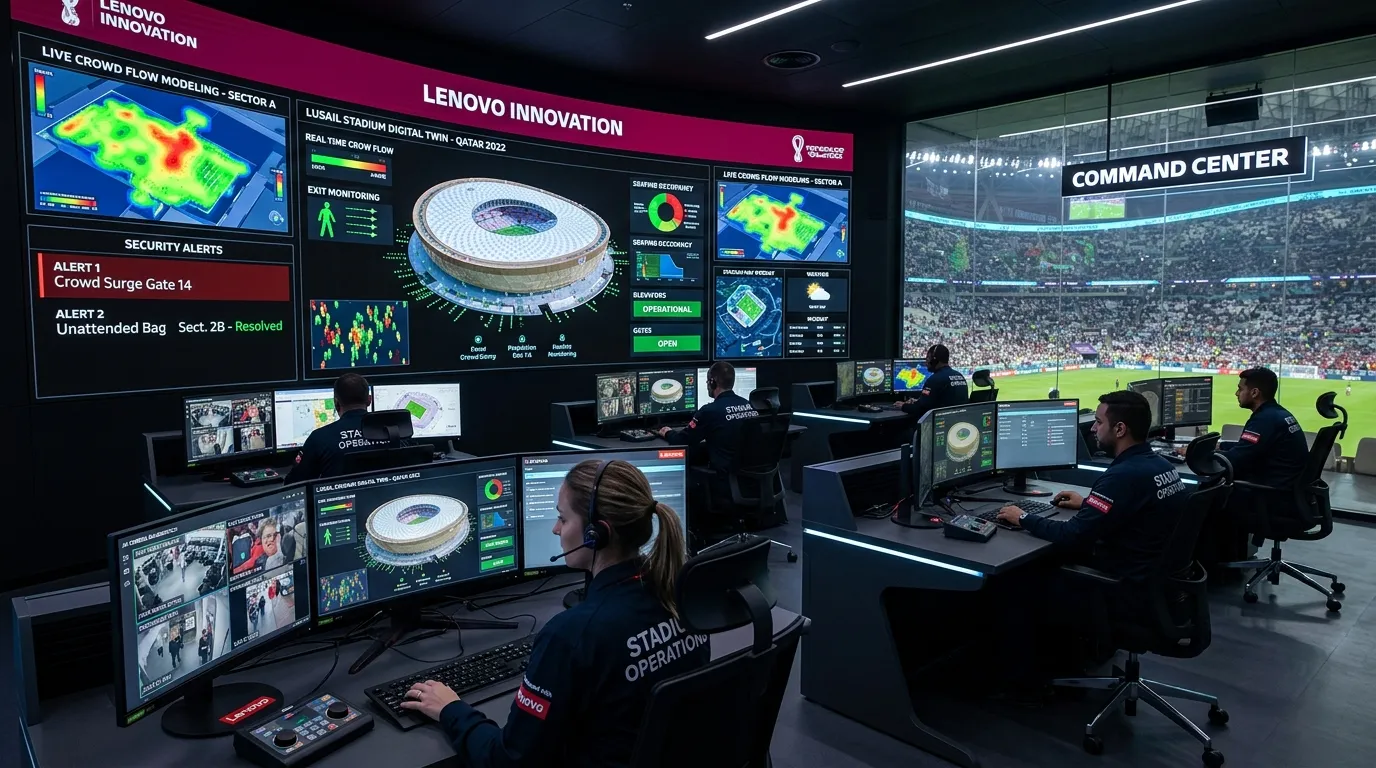
- Lenovo Innovation: AI Stadium Operations and Infrastructure Showcase — Inside look at the digital twin stadium management system and Intelligent Command Center powering crowd safety.
Further Reading
- Official FIFA Semi-Automated Offside Technology Landing Page — Detailed official portal explaining the camera setup, ball tracking sensor integration, and the workflow of SAOT.
- FIFA Innovation Hub: Offside Decisions, Referee Body Cams & Tournament Tech — FIFA’s official news release outlining the testing, certification, and rollout of officiating technology at the 2026 World Cup.
- Living Football: Semi-Automated Offside Technology Explainer — FIFA’s official Living Football series media centre page detailing the technology.
- YouTube: FIFA Semi-Automated Offside Technology Search Results — Curated list of search results featuring video explainers and broadcaster reports of the system in action.
- YouTube: Adidas Connected Ball Technology Search Results — Video demonstrations and analysis covering the Adidas Trionda Kinexon sensor and kick-point telemetry.
Frequently Asked Questions
Is SAOT fully automated? Will it replace referees?
No. The “semi” in SAOT means the system proposes offside lines and kick-points, but VAR officials must confirm every decision. The on-field referee retains final authority and can initiate an On-Field Review. FIFA has stated fully automated offside (no human review) is a 2030 target, not a 2026 reality.
How accurate is the Trionda’s kick-point detection?
±2-3 milliseconds (vs. ±20ms with cameras alone). The 500Hz IMU detects the impact transient (peak acceleration >50g) and timestamps it. Fusion with 50Hz optical frames uses interpolation — the IMU spike anchors the exact frame. Independent testing at the 2025 Club World Cup showed 99.7% agreement between IMU and high-speed camera (1000Hz) ground truth.
Can teams opt out of FIFA Football Data sharing?
No. Participation in the World Cup requires acceptance of the data-sharing terms in the tournament regulations. However, player-level data ownership remains with the federation — FIFA only uses aggregated, anonymized data for tournament trends and development reports.
Will VAR audio be broadcast live?
Not in 2026. FIFA continues to resist live VAR audio (unlike rugby’s TMO or cricket’s DRS). The stated reason: protecting officials from targeted abuse. However, FIFA has committed to post-match VAR audio releases for all reviewed incidents — a transparency improvement over 2022.
How does the technology handle indoor/retractable-roof venues?
Eight venues have roofs. FIFA’s tracking cameras are mounted below the roof structure (not on it), so roof position doesn’t affect coverage. The University of Tennessee–Michigan State turf research ensured consistent grass properties regardless of roof state. Calibration routines run pre-match and at halftime to account for any thermal expansion of camera mounts.
What to Read Next
- How Semi-Automated Offside Technology Works: A Technical Deep Dive — a closer look at the 2026 system architecture, with camera placement diagrams.
- FIFA Football Data Platform: Team Analyst’s Guide — a practical walkthrough for folding standardized tracking metrics into match preparation.
- The Evolution of World Cup Match Balls: From Telstar to Trionda — 54 years of ball technology, ending with the first panel-mounted IMU.
Sources & References
Primary Sources
- FIFA.com — Innovation Hub (football technology, VAR, SAOT, connected ball)
- FIFA.com — 2026 FIFA World Cup News (official tournament technology announcements)
- Wikipedia — 2026 FIFA World Cup (tournament structure, venues, format, officiating)
- Wikipedia — Semi-automated offside technology (technical specification, implementation history)
- Wikipedia — Video assistant referee (VAR protocol, history, 2026 expansions)
- Wikipedia — Adidas Trionda (ball specification, IMU details, production)
- Wikipedia — Adidas Al Rihla (2022 predecessor, bladder-suspended IMU comparison)
- Wikipedia — Goal-line technology (Hawk-Eye/Vieww, venue counts, requirements)
- Wikipedia — 2025 FIFA Club World Cup (AI-enhanced SAOT testbed)
- IFAB — Laws of the Game 2025/26 (VAR protocol, new review categories, substitution/restart rules)
Technical & Industry Sources
- Kinexon — Connected Ball Technology Whitepaper (IMU specification, data protocol)
- Hawk-Eye Innovations — Goal-Line Technology Technical Dossier (camera geometry, latency specs)
- FIFA Quality Programme — GLT Testing Manual (licensing requirements, installation test)
- UEFA — SAOT at Euro 2024 Technical Report (10-camera config, connected ball integration)
- Premier League — SAOT Introduction Statement (optical tracking, 31-second average time saving)
Broadcast & Analytics Sources
- FIFA+ — Digital Strategy 2023-2027 (AI commentary, preferred platform deals)
- Reuters — FIFA Club World Cup 2025 Technology Report (AI frame interpolation, centralized VAR hub)
- Associated Press — Premier League SAOT FA Cup Trial (31-second time saving, accuracy data)
- The Athletic — FIFA Football Data Platform Deep Dive (schema, team access, privacy model)
- SportBusiness — World Cup 2026 Broadcast Rights & Technology (TikTok/YouTube deals, IBC Dallas, recap automation)
A Note on the Numbers
A few figures here are worth flagging on their provenance. The ball specs (IMU placement, 500Hz sampling) trace back to the Adidas Trionda’s Wikipedia entry, which itself cites FIFA and Adidas press releases from October 2025, cross-checked against Kinexon’s own technical documentation. The officiating counts — 30 VARs, 52 referees, 88 assistant referees — come from FIFA’s April 9, 2026 appointment announcement. And the SAOT camera and body-point figures (16 per venue, 29 points per player) show up consistently across FIFA’s own 2026 materials, UEFA’s Euro 2024 report, and the current Wikipedia entry, which is about as close to consensus as this kind of spec gets before FIFA publishes anything more formal.
Everything else traces back to the sources above; where a stat changes mid-tournament (match counts, review-latency averages), we’ve noted the as-of date inline. Stats in this piece are current to July 4, 2026, with 60 matches played.