
Most AI assistants forget. You ask them something, they answer, and next conversation they start from zero. Hermes Agent doesn’t work that way. It remembers what you teach it, creates its own solutions, and gets smarter with every task.
If you’ve heard about AI agents but weren’t sure what they actually do—or why Hermes is different from ChatGPT, Claude, or just throwing API calls at OpenAI—this guide is for you.
What Is Hermes Agent?
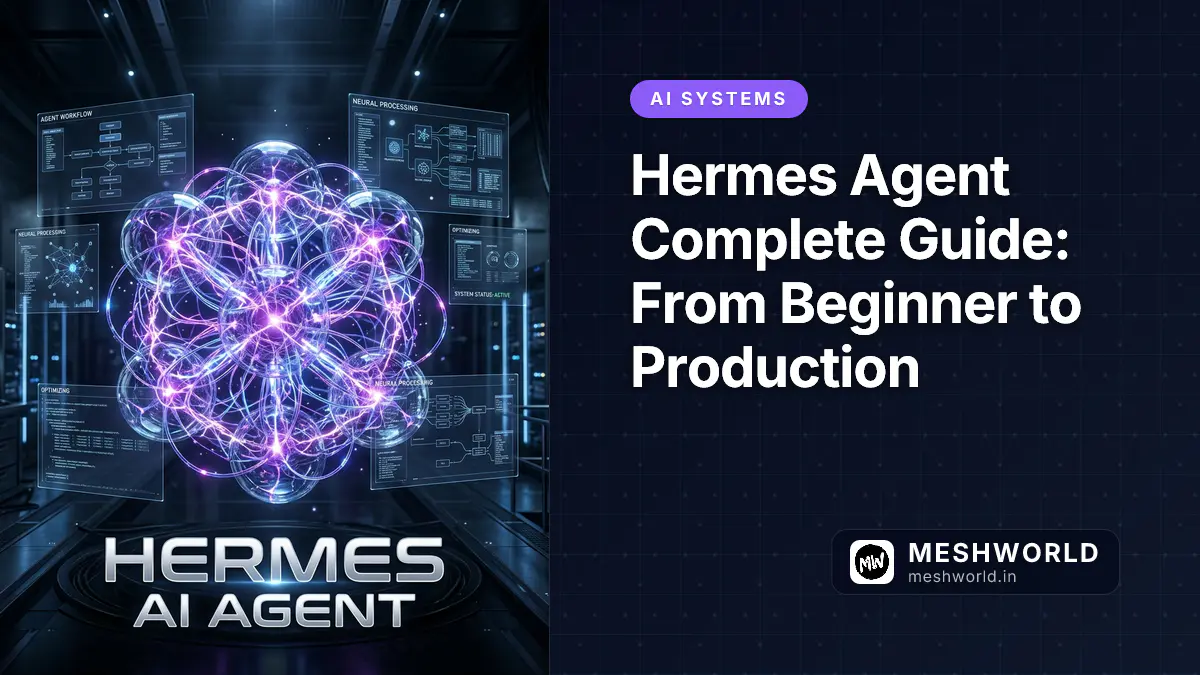
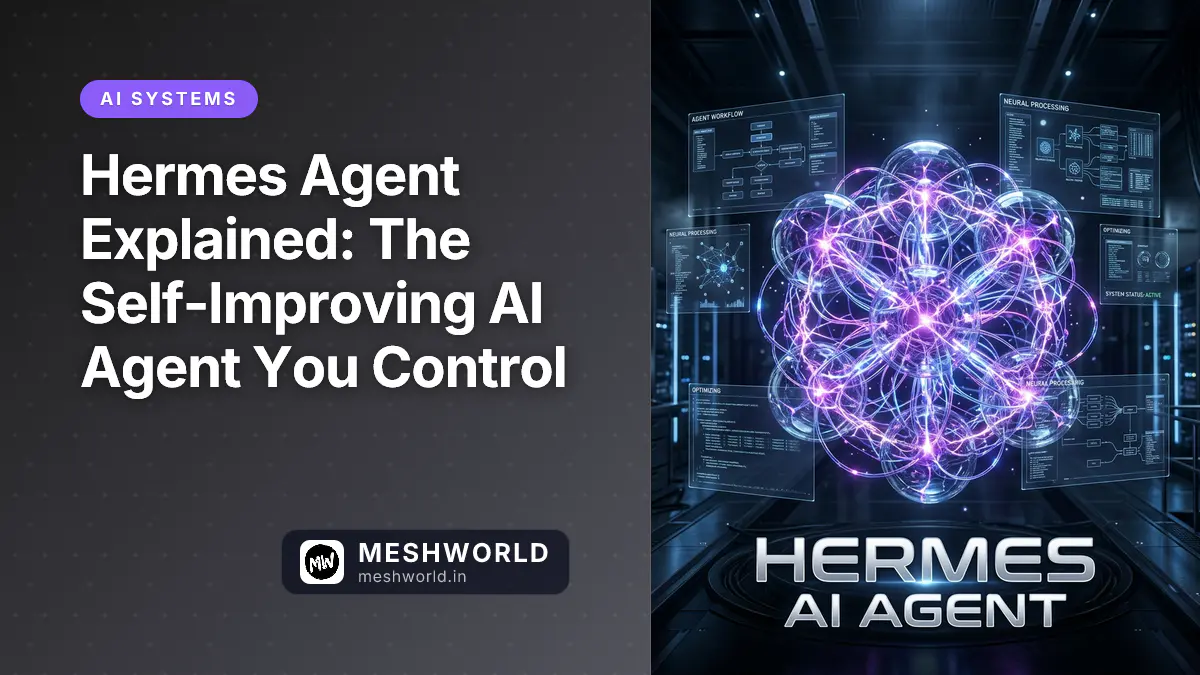
Hermes Agent is an autonomous AI framework built by Nous Research and released in February 2026. It’s open source (MIT license), runs on your own machine or server, and learns over time by solving tasks repeatedly.
Here’s the key difference: Most AI tools are stateless. They’re like talking to a stranger every single time. Hermes has memory. It:
- Solves tasks and captures what it did
- Writes skill documents (reusable instructions it creates itself)
- Stores everything in memory (conversations, solutions, preferences)
- Improves next time it sees a similar task
Real example: First time you ask Hermes to fetch your weekly sales report, it figures out the steps. Second time? It retrieves the skill it wrote, runs it faster, and refines the approach. Nous Research benchmarks show repeated tasks complete 40% faster with self-generated skills.
The Numbers (As of April 2026)
- 124,000+ GitHub stars — fastest-growing agent framework of 2026
- Hit 95,600 stars in 7 weeks — from launch (Feb 25, 2026)
- Zero reported CVEs — more on that later
- Open source, MIT license — use commercially without restrictions
- Multi-platform out of the box — Telegram, Discord, Slack, WhatsApp, Signal, Email, CLI
How It’s Different: The Learning Loop
Most agents execute. Hermes executes and learns.
Traditional AI Agent:
Task → Execute → Response → Done (next task starts fresh)

Hermes Agent:
Task → Execute → Document Approach → Store in Memory →
  Next Similar Task → Retrieve Skill → Execute Better → Refine
This is Hermes’s defining feature. It’s not just running LLMs faster or managing tools better. It’s building a permanent knowledge base of what works.
Why You’d Actually Use This
Personal productivity: Hermes runs on Discord, Slack, or Telegram. You teach it your workflows. Over weeks, it learns your patterns, preferences, and shortcuts. It becomes smarter than a fresh ChatGPT session because it’s read your entire history.
Internal company tools: Tired of writing the same integration scripts? Hermes learns your company’s APIs, builds tools for them, refines those tools as it uses them.
Privacy-critical work: Your data never leaves your machine if you run Hermes locally with a local LLM (like Ollama). No vendor lock-in, no usage tracking.
Cost optimization: One API call to OpenAI costs money. Hermes + local Ollama? No API costs. Just runs on your hardware.
Hermes vs. Cloud APIs (ChatGPT, Claude, etc.)
| Aspect | Hermes Agent | Cloud APIs |
|---|---|---|
| Where it runs | Your machine or server | Company’s servers |
| Memory | Persistent (learns over time) | Session-based (forgets) |
| Privacy | Full control, offline option | Data sent to provider |
| Cost | Free software + hardware | Per-API-call pricing |
| Learning loop | Self-improves skills | No improvement mechanism |
| Setup time | ~15 minutes | Instant (but account signup) |
You’re not comparing a database to a spreadsheet. You’re comparing a system that learns to one that forgets.
Hermes vs. OpenClaw (The Other Open-Source Agent)
Both are open source, both let you build autonomous AI. But they’re fundamentally different:
Hermes (Agent-First)
- Built around self-improvement and memory
- Agent learns your patterns
- Skills self-generated (zero external risk)
- Simpler to set up
- 124K stars, explosive growth
OpenClaw (Gateway-First)
- Built around tool coverage and routing
- Broader ecosystem, more integrations
- Skills from community marketplace (dangerous: 341 malicious skills found in 2026 attack)
- More complex setup
- 345K+ stars, established community
If you want an agent that learns, pick Hermes. If you need broad tool coverage and don’t mind the added setup complexity, OpenClaw works. Many teams use both.
Real-World Scenario: Why This Matters
You work at a 15-person startup. Every Friday you compile:
- Weekly metrics from three different tools
- Create a status report
- Send it to your team
First time with ChatGPT: You write a perfect prompt, get a good report.
Next Friday: You write the same prompt, but ChatGPT doesn’t remember last week. It doesn’t know your template. You’re starting over.
First time with Hermes: You ask it to create the report. It learns the process, your tools, your format.
Next Friday: Hermes retrieves last week’s skill, runs it in 30 seconds, refines based on feedback. Week 4? It’s predicting what metrics you’ll need and proactively gathering them.
That’s the learning loop. It’s boring to describe, but it changes how you work.
Multiplatform: Hermes Lives Where You Work
Hermes isn’t just a CLI tool. It connects to:
- Discord — runs in your server, learns from team conversations
- Slack — bot in your workspace, persistent context
- Telegram — personal assistant in your pocket
- WhatsApp — same thing, different platform
- Signal — if privacy is critical
- Email — Hermes reads your inbox, responds
- CLI — for dev work and testing
One Hermes instance. Multiple platforms. Unified memory across all of them. Ask something in Slack, Hermes remembers it in Discord later.
The Security Angle (And Why It Matters)
OpenClaw has a skill marketplace. Community members upload skills. In January 2026, the ClawHavoc attack identified 341 malicious skills among 2,857 total—a supply chain attack that could give attackers code execution.
Hermes doesn’t have a community marketplace. Skills are self-generated. You can’t upload untrusted code. Attack surface eliminated.
Zero reported CVEs for Hermes as of April 2026. Not zero known CVEs—zero reported. That’s different. But it’s a strong signal.
(This doesn’t mean Hermes is immune to security issues. It means the architecture removes an entire class of attacks that hit OpenClaw.)
What You Need to Actually Use It
Minimum:
- 4GB RAM (8GB recommended)
- 2GB disk space
- Linux, macOS, WSL2, or Android (Termux)
- Nothing else—truly that simple
Optional (makes it way better):
- Ollama installed (for local LLMs, no API costs)
- Discord/Slack/Telegram account (to connect bot)
- GPU with 4GB+ VRAM (if you want fast local inference)
Installation is literally one bash command. We’ll cover that in the next article.
Common Questions (Really Common)
Q: Is this just running local LLMs? No. You can use local LLMs (Ollama), but Hermes also works with cloud APIs (OpenAI, Anthropic, OpenRouter). The learning loop is the unique part, not the inference method.
Q: Do I need to code to use this? Not for basic use. Connect it to Discord, ask it to do stuff. It’ll learn. Advanced customization (writing tools) requires some coding.
Q: Can I run this on a server in the cloud? Yes. Deploy to AWS, DigitalOcean, whatever. Just point Discord/Slack/Telegram at it.
Q: How much does it cost? The software is free (MIT license). Cost depends on:
- If you use local Ollama: just electricity, so ~$0/month
- If you use OpenAI: maybe $10-50/month depending on usage
- If you run on cloud infrastructure: hosting costs
Q: Will my data stay private? Yes, if you run locally. Hermes stores everything locally by default. No telemetry, no cloud sync, nothing leaves your machine without you explicitly sending it.
Q: Is it stable/production-ready? Hermes launched February 2026. It’s 2 months old. There are production deployments, but it’s not as battle-tested as OpenClaw. The growth is explosive partly because it’s new and interesting.
Q: Can I combine Hermes with other tools? Yes. Many teams use Hermes + OpenClaw together, Hermes + traditional APIs, etc. It’s open source—integrate whatever you want.
What Happens Next
You now know what Hermes is. The learning loop. Why it’s different. The basics.
Next, we’ll install it (15 minutes) and set up your first bot on Discord or Slack. Then you’ll see the learning loop in action.
What to Read Next
- Install Hermes Agent in 15 Minutes — Step-by-step setup
- How Hermes Learns: Architecture Deep Dive — Understand how the learning loop actually works
- Hermes vs. OpenClaw: A Detailed Comparison — Which framework is right for you?